

Wealth Daily
Chip Shares Retreat as AI Leadership Scrutiny Intensifies
Today’s Must-Know News
Overnight Markets
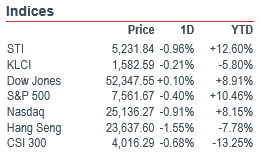
Market Movers: U.S. and Hong Kong equities retreated on 13 November, with the S&P 500 falling 0.40%, the Nasdaq losing 0.91% and the Hang Seng declining 1.55%. Nvidia (NVDA US) fell 2.01% amid scrutiny of its leadership transition, while Advanced Micro Devices (AMD US) dropped 8.75% as semiconductor selling broadened. Cisco (CSCO US) lost 6.24% after 12 November results, despite targeting US$9bn in FY27 hyperscaler AI revenue. Strong spending plans alone are insufficient without order conversion and earnings delivery. (Reuters / Cisco / StockAnalysis / AP / Eastmoney) Nvidia (NVDA US) is our Core Recommendation.
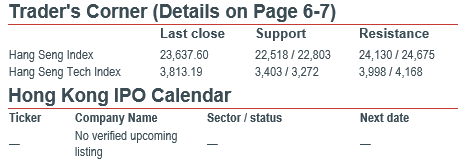
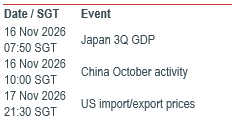
Macro: US producer prices rose 0.3% in October, slowing from September’s 1.4% increase, but annual inflation reached 6.5%. Excluding food, energy and trade services, prices rose 0.5% monthly and 4.9% annually. China’s yuan loans meanwhile contracted RMB100bn in October against a RMB100bn increase expected in Caixin’s survey. Persistent US price pressure and weak Chinese borrowing complicate the policy outlook. Japan’s GDP release on 16 November 2026 at 07:50 SGT and China’s activity data at 10:00 SGT will provide fresh tests of regional demand. (BLS / Caixin / PBOC via Tonghuashun / Cabinet Office / NBS)
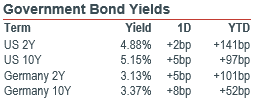
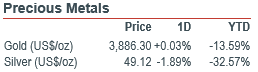
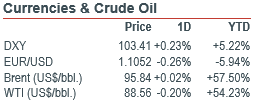
FICC: The US 10 year Treasury yield rose 5bps to 5.15%, while Germany’s 10-year yield increased 8bps to 3.37%. December silver futures fell 1.89% to US$49.12/oz, contrasting with a 0.03% gain in December gold to US$3,886.30/oz. January Brent settled at US$95.84/bbl, up 0.02%, and December WTI slipped 0.20% to US$88.56/bbl. Higher sovereign yields raise the discount-rate hurdle for long-duration assets, while the divergence between precious metals cautions against treating them as a single inflation trade. (US Treasury / Bundesbank / eOption / Xinhua)
AI
- Nvidia succession scrutiny deepens. Nvidia (NVDA US) fell 2.0% Friday as succession uncertainty weighed on AI shares. Separately on Sunday, Treasury Secretary Scott Bessent urged an external chief executive and answers within 10 days on export-compliance culture. Reuters also cited the FT’s report that directors approached Arm’s Rene Haas; no appointment was confirmed. Leadership and regulatory uncertainty could complicate funding relationships across the AI supply chain. (Reuters / Reuters) Nvidia (NVDA US) is our Core Recommendation.
Tencent brings tool use to live voice conversations. Tencent (0700.HK) released Hy Realtime, a speech model combining conversational voice with search, tool calling and singing. It is already available in Yuanbao voice calls and Tencent customer service; a Tencent Cloud API remains planned. The deployment extends AI interaction beyond text into consumer and service workflows, although disclosed pricing and adoption metrics are absent. Revenue implications therefore depend on usage and eventual enterprise access. (IT Home) Tencent (0700.HK) is our Core Recommendation.
OpenAI opens agent payments. OpenAI launched ChatGPT Wallet for a limited group of US Pro users, connecting American Express, Mastercard and Visa credentials to agent purchases. The company cited 1.2bn weekly ChatGPT users, but this initial rollout requires approval and a security check for every purchase. Tokenised card data protects account details. Distribution could expand merchant access, although fully delegated spending and broader compatibility remain future ambitions rather than current capabilities. (OpenAI)
Cerebras raises its revenue outlook. Cerebras (CBRS US) gained 11.2% Friday after forecasting annual adjusted revenue of US$940–960m, up from US$880–890m. Third-quarter adjusted revenue rose 70% to US$230.9m, while adjusted profit reached US$29.82m versus a US$10.86m loss. A new Microsoft cloud agreement broadens customer demand, with further details due next year. Execution and customer concentration remain important as contracted capacity converts into recognised revenue. (Reuters)
Americas
AMD leads the chip retreat. Advanced Micro Devices (AMD US) dropped 8.8% Friday as investors reduced semiconductor exposure amid Nvidia’s leadership uncertainty. The Philadelphia semiconductor index lost 3.4%, underscoring the sector-wide nature of the retreat rather than a newly announced AMD earnings warning. The reaction highlights shared exposure to AI infrastructure financing and customer capital expenditure; diversifying chip suppliers does not eliminate the industry’s underlying demand and funding risks. (Reuters)
Microsoft restores email services. Microsoft (MSFT US) declared its global email disruption resolved late Friday after roughly 30 hours affecting more than 70 countries. GeekWire reported that a recent network change exposed an earlier fault, causing cascading failures, with reconnecting users adding strain during recovery. The episode exposes operational concentration in cloud productivity services and reinforces demand for continuity planning. It was distinct from the separate US aviation ground stop. (GeekWire) Microsoft (MSFT US) is our Core Recommendation.
Amazon satellite launch fails. Amazon (AMZN US) lost 40 Leo satellites when a United Launch Alliance Vulcan mission failed Sunday, with an anomaly about 10 minutes after liftoff. The mission was the first of 38 contracted Vulcan launches supporting the broadband constellation. The cause remained unknown. Investigation and return-to-flight timing could disrupt deployment cadence, although the incident’s financial impact and any change to customer-service targets were not quantified. (Reuters / ULA) Amazon (AMZN US) is our Core Recommendation.
Meta faces an Italian privacy fine. Italy’s privacy regulator fined Meta Platforms (META US) €805m over Facebook’s access to Android photo galleries without separate consent, affecting about 20m Italian users. It ordered changes within 60 days; Meta disputed the decision and plans to appeal. The ruling concerns gallery access rather than an established AI-training violation. Stronger consent requirements could constrain product design and increase compliance costs while the legal challenge proceeds. (Garante / Reuters / Hurriyet) Meta Platforms (META US) is our Core Recommendation.
SpaceX catches an orbital upper stage. SpaceX (SPCX US) caught a Starship upper stage returning from orbit Saturday after a roughly 22.5-hour mission that deployed 26 Starlink V3 satellites. The booster instead splashed down following a low-fuel warning, so both stages were not recovered. The upper-stage milestone advances potential launch-cost reductions, but inspection, refurbishment and successful reflight remain necessary before routine full reusability can be demonstrated. (Space.com)
Cisco falls despite AI growth outlook Cisco Systems (CSCO US) fell 6.2% Friday following Thursday’s results. Quarterly revenue rose 24% to US$18.5bn, and the company projected fiscal 2027 revenue of US$74.8–75.8bn, including US$9bn from hyperscaler AI infrastructure. The completed-session decline illustrates that strong demand does not insulate suppliers from sector repricing; investors still need to assess margins and conversion of infrastructure orders into sustainable earnings. (Cisco / StockAnalysis)
Merck gains a positive EU opinion. Merck (MRK US) received a positive European committee opinion for Welireg combined with lenvatinib in previously treated advanced clear-cell kidney cancer. The supporting trial reduced progression or death risk by 26%, although the final overall-survival analysis was not statistically significant. A European Commission decision is expected within two months. The proposed indication offers a commercial expansion opportunity, subject to final approval and the clinical evidence’s limitations. (Merck / EMA)
Greater China
CATL expands its battery-swap network ambitions. CATL (300750.SZ) unveiled additional battery-swap vehicles with BAIC on Friday and outlined a network of 6,000 stations across 297 cities by 2027. The company had 2,520 stations in 200 cities at September-end. The launch advances an October cooperation agreement rather than constituting a new contract. Wider vehicle compatibility could improve station utilisation, but the expansion also requires investment before recurring service revenue scales. (China Fund / Securities Daily) CATL (300750.SZ) is our Core Recommendation.
SMIC warns equipment delays complicate expansion. SMIC (0981.HK) said on Friday's earnings call that equipment suppliers were quoting delivery times of 16–24 months, with rising prices adding uncertainty to capital-spending execution. Management expects foundry supply to remain tight in 2027. Third-quarter average wafer prices rose 1.8% sequentially and shipments increased 5.7%. Longer lead times could slow capacity additions despite firm demand, making equipment availability as important as financing for expansion. (STAR Market Daily)
China's loan contraction signals weak borrowing demand. China's yuan loans contracted by RMB100bn in October, compared with the RMB100bn increase expected in Caixin's economist survey. Lending increased RMB11.42tn over the first ten months, RMB3.55tn less than a year earlier. Aggregate financing rose RMB28.61tn over that period, down RMB2.29tn year on year. The figures suggest policy-supported financing has yet to generate a broad private-credit recovery, limiting the transmission of easier funding into demand. (Caixin / PBOC via Tonghuashun)
Hong Kong raises its growth forecast. Hong Kong raised its full-year real GDP growth forecast to 4.8% following third-quarter expansion of 5.2% year on year. Goods exports grew 30.3% in real terms, supported by global demand for AI-related electronics, while private consumption increased 2.9%. The upgrade highlights external trade's outsized contribution to the recovery; a reversal in AI investment or renewed trade restrictions would therefore pose risks despite firmer domestic spending. (Hong Kong Government)
Asia ex. China
MUFG raises profit and dividend targets. Mitsubishi UFJ Financial Group (8306.T) lifted its annual net-profit target to JPY2.8tn from JPY2.7tn and its dividend forecast to JPY100 from JPY96 per share, citing stronger customer businesses and Morgan Stanley earnings. Japan's other megabanks also upgraded forecasts. MUFG disclosed JPY3.3tn of data-centre credit against JPY180tn of total credit, showing that AI infrastructure lending warrants monitoring even as stronger earnings increase shareholder distributions. (Company / Reuters)
Singtel lifts its operating-profit outlook. Singtel (Z74.SI) raised full-year operating-company EBIT growth guidance to mid-to-high single digits as first-half underlying net profit rose 10% to S$1.49bn. Reported profit fell 55% to S$1.54bn because the prior period included S$2.21bn of exceptional gains. Its interim dividend increased 10% to 9 Singapore cents. The underlying improvement supports distributions, while the statutory decline illustrates why disposal gains should be separated from recurring earnings. (Company / Reuters)
EMEA and Others
Jewellery expectations temper a strong profit recovery. Richemont (CFR SW) fell 3.8% as 2Q jewellery sales rose 14% at constant currencies to €4.41bn, below the 16% consensus increase. Group sales of €5.95bn exceeded the €5.89bn forecast. First-half operating profit grew 33% to €3.1bn, including €229m of positive one-off tariff items. Underlying demand and margins therefore provide a more useful earnings test than the headline profit increase. (Richemont / Reuters / Reuters)
Insurance earnings withstand catastrophe losses. Generali (G IM) reported 9M operating profit of €6.45bn, up 8.5%, and adjusted net profit of €3.68bn, up 12.0%, despite €1.5bn of natural-catastrophe claims. Gross premiums grew 4.5% on a comparable basis to €76.5bn. The insurer expects to exceed its 2027 plan targets. A 211% solvency ratio, versus 219% at FY25, makes capital resilience important alongside continued underwriting growth. (Generali / Reuters)
Premium growth and wealth flows support the outlook. Aviva (AV LN) rose 3.41% after reporting 9M general-insurance premiums of £11.8bn, up 19%, and wealth net inflows of £10.9bn, up 31%. The undiscounted combined ratio improved to 93.8% from 94.4%, while wealth assets reached £267bn. Management expects roughly 11% EPS growth this year. Maintaining underwriting discipline alongside inflow growth is the key test of that earnings outlook. (Aviva / StockAnalysis)
Traders' Corner
Our Technical View
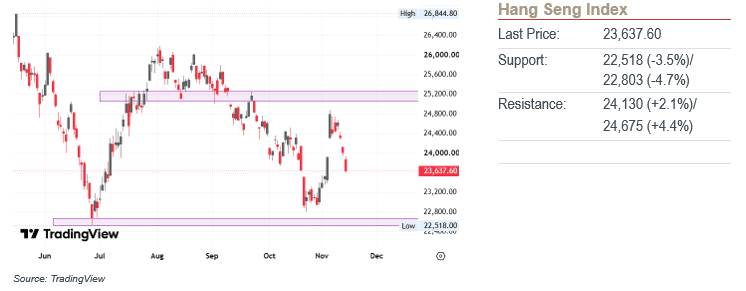
Weekly Chart: Price formed a long bearish candlestick on the weekly timeframe after failing to breach overhead resistance at the previous price high. The weekly RSI remains in bearish territory and is turning downward just below the 50 neutral baseline. As long as price remains capped below the previous high resistance ceiling, we see continued downward continuation toward swing support.
Daily Chart: Price completely closing the gap support zone on heavy selling pressure. The RSI has turned bearish and is falling with accelerating negative velocity. As long as price remains capped below the closed gap-support boundary, we see continued downward extension toward underlying swing low support targets.
Our Technical View
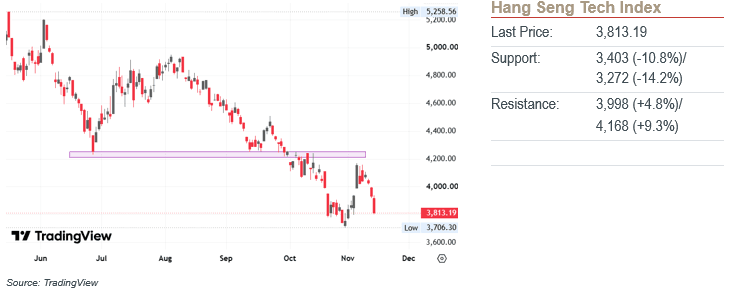
Weekly Chart: Price was rejected at its support-turned-resistance ceiling. The weekly RSI remains weak, deeply entrenched in bearish territory, and is accelerating downward with negative velocity. As long as price remains capped below the converted resistance, we see continued downward expansion toward underlying support targets.
Daily Chart: Price was rejected at its overhead resistance zone and extending its downward trajectory. The RSI has turned bearish and is falling with accelerating negative velocity. As long as price remains capped below the resistance ceiling, we see continued downward extension toward underlying swing low support.
Market Movers: U.S. and Hong Kong equities retreated on 13 November, with the S&P 500 falling 0.40%, the Nasdaq losing 0.91% and the Hang Seng declining 1.55%. Nvidia (NVDA US) fell 2.01% amid scrutiny of its leadership transition, while Advanced Micro Devices (AMD US) dropped 8.75% as semiconductor selling broadened. Cisco (CSCO US) lost 6.24% after 12 November results, despite targeting US$9bn in FY27 hyperscaler AI revenue. Strong spending plans alone are insufficient without order conversion and earnings delivery. (Reuters / Cisco / StockAnalysis / AP / Eastmoney) Nvidia (NVDA US) is our Core Recommendation.
Macro: US producer prices rose 0.3% in October, slowing from September’s 1.4% increase, but annual inflation reached 6.5%. Excluding food, energy and trade services, prices rose 0.5% monthly and 4.9% annually. China’s yuan loans meanwhile contracted RMB100bn in October against a RMB100bn increase expected in Caixin’s survey. Persistent US price pressure and weak Chinese borrowing complicate the policy outlook. Japan’s GDP release on 16 November 2026 at 07:50 SGT and China’s activity data at 10:00 SGT will provide fresh tests of regional demand. (BLS / Caixin / PBOC via Tonghuashun / Cabinet Office / NBS)
FICC: The US 10 year Treasury yield rose 5bps to 5.15%, while Germany’s 10-year yield increased 8bps to 3.37%. December silver futures fell 1.89% to US$49.12/oz, contrasting with a 0.03% gain in December gold to US$3,886.30/oz. January Brent settled at US$95.84/bbl, up 0.02%, and December WTI slipped 0.20% to US$88.56/bbl. Higher sovereign yields raise the discount-rate hurdle for long-duration assets, while the divergence between precious metals cautions against treating them as a single inflation trade. (US Treasury / Bundesbank / eOption / Xinhua)
AI
- Nvidia succession scrutiny deepens. Nvidia (NVDA US) fell 2.0% Friday as succession uncertainty weighed on AI shares. Separately on Sunday, Treasury Secretary Scott Bessent urged an external chief executive and answers within 10 days on export-compliance culture. Reuters also cited the FT’s report that directors approached Arm’s Rene Haas; no appointment was confirmed. Leadership and regulatory uncertainty could complicate funding relationships across the AI supply chain. (Reuters / Reuters) Nvidia (NVDA US) is our Core Recommendation.
Tencent brings tool use to live voice conversations. Tencent (0700.HK) released Hy Realtime, a speech model combining conversational voice with search, tool calling and singing. It is already available in Yuanbao voice calls and Tencent customer service; a Tencent Cloud API remains planned. The deployment extends AI interaction beyond text into consumer and service workflows, although disclosed pricing and adoption metrics are absent. Revenue implications therefore depend on usage and eventual enterprise access. (IT Home) Tencent (0700.HK) is our Core Recommendation.
OpenAI opens agent payments. OpenAI launched ChatGPT Wallet for a limited group of US Pro users, connecting American Express, Mastercard and Visa credentials to agent purchases. The company cited 1.2bn weekly ChatGPT users, but this initial rollout requires approval and a security check for every purchase. Tokenised card data protects account details. Distribution could expand merchant access, although fully delegated spending and broader compatibility remain future ambitions rather than current capabilities. (OpenAI)
Cerebras raises its revenue outlook. Cerebras (CBRS US) gained 11.2% Friday after forecasting annual adjusted revenue of US$940–960m, up from US$880–890m. Third-quarter adjusted revenue rose 70% to US$230.9m, while adjusted profit reached US$29.82m versus a US$10.86m loss. A new Microsoft cloud agreement broadens customer demand, with further details due next year. Execution and customer concentration remain important as contracted capacity converts into recognised revenue. (Reuters)
Americas
AMD leads the chip retreat. Advanced Micro Devices (AMD US) dropped 8.8% Friday as investors reduced semiconductor exposure amid Nvidia’s leadership uncertainty. The Philadelphia semiconductor index lost 3.4%, underscoring the sector-wide nature of the retreat rather than a newly announced AMD earnings warning. The reaction highlights shared exposure to AI infrastructure financing and customer capital expenditure; diversifying chip suppliers does not eliminate the industry’s underlying demand and funding risks. (Reuters)
Microsoft restores email services. Microsoft (MSFT US) declared its global email disruption resolved late Friday after roughly 30 hours affecting more than 70 countries. GeekWire reported that a recent network change exposed an earlier fault, causing cascading failures, with reconnecting users adding strain during recovery. The episode exposes operational concentration in cloud productivity services and reinforces demand for continuity planning. It was distinct from the separate US aviation ground stop. (GeekWire) Microsoft (MSFT US) is our Core Recommendation.
Amazon satellite launch fails. Amazon (AMZN US) lost 40 Leo satellites when a United Launch Alliance Vulcan mission failed Sunday, with an anomaly about 10 minutes after liftoff. The mission was the first of 38 contracted Vulcan launches supporting the broadband constellation. The cause remained unknown. Investigation and return-to-flight timing could disrupt deployment cadence, although the incident’s financial impact and any change to customer-service targets were not quantified. (Reuters / ULA) Amazon (AMZN US) is our Core Recommendation.
Meta faces an Italian privacy fine. Italy’s privacy regulator fined Meta Platforms (META US) €805m over Facebook’s access to Android photo galleries without separate consent, affecting about 20m Italian users. It ordered changes within 60 days; Meta disputed the decision and plans to appeal. The ruling concerns gallery access rather than an established AI-training violation. Stronger consent requirements could constrain product design and increase compliance costs while the legal challenge proceeds. (Garante / Reuters / Hurriyet) Meta Platforms (META US) is our Core Recommendation.
SpaceX catches an orbital upper stage. SpaceX (SPCX US) caught a Starship upper stage returning from orbit Saturday after a roughly 22.5-hour mission that deployed 26 Starlink V3 satellites. The booster instead splashed down following a low-fuel warning, so both stages were not recovered. The upper-stage milestone advances potential launch-cost reductions, but inspection, refurbishment and successful reflight remain necessary before routine full reusability can be demonstrated. (Space.com)
Cisco falls despite AI growth outlook Cisco Systems (CSCO US) fell 6.2% Friday following Thursday’s results. Quarterly revenue rose 24% to US$18.5bn, and the company projected fiscal 2027 revenue of US$74.8–75.8bn, including US$9bn from hyperscaler AI infrastructure. The completed-session decline illustrates that strong demand does not insulate suppliers from sector repricing; investors still need to assess margins and conversion of infrastructure orders into sustainable earnings. (Cisco / StockAnalysis)
Merck gains a positive EU opinion. Merck (MRK US) received a positive European committee opinion for Welireg combined with lenvatinib in previously treated advanced clear-cell kidney cancer. The supporting trial reduced progression or death risk by 26%, although the final overall-survival analysis was not statistically significant. A European Commission decision is expected within two months. The proposed indication offers a commercial expansion opportunity, subject to final approval and the clinical evidence’s limitations. (Merck / EMA)
Greater China
CATL expands its battery-swap network ambitions. CATL (300750.SZ) unveiled additional battery-swap vehicles with BAIC on Friday and outlined a network of 6,000 stations across 297 cities by 2027. The company had 2,520 stations in 200 cities at September-end. The launch advances an October cooperation agreement rather than constituting a new contract. Wider vehicle compatibility could improve station utilisation, but the expansion also requires investment before recurring service revenue scales. (China Fund / Securities Daily) CATL (300750.SZ) is our Core Recommendation.
SMIC warns equipment delays complicate expansion. SMIC (0981.HK) said on Friday's earnings call that equipment suppliers were quoting delivery times of 16–24 months, with rising prices adding uncertainty to capital-spending execution. Management expects foundry supply to remain tight in 2027. Third-quarter average wafer prices rose 1.8% sequentially and shipments increased 5.7%. Longer lead times could slow capacity additions despite firm demand, making equipment availability as important as financing for expansion. (STAR Market Daily)
China's loan contraction signals weak borrowing demand. China's yuan loans contracted by RMB100bn in October, compared with the RMB100bn increase expected in Caixin's economist survey. Lending increased RMB11.42tn over the first ten months, RMB3.55tn less than a year earlier. Aggregate financing rose RMB28.61tn over that period, down RMB2.29tn year on year. The figures suggest policy-supported financing has yet to generate a broad private-credit recovery, limiting the transmission of easier funding into demand. (Caixin / PBOC via Tonghuashun)
Hong Kong raises its growth forecast. Hong Kong raised its full-year real GDP growth forecast to 4.8% following third-quarter expansion of 5.2% year on year. Goods exports grew 30.3% in real terms, supported by global demand for AI-related electronics, while private consumption increased 2.9%. The upgrade highlights external trade's outsized contribution to the recovery; a reversal in AI investment or renewed trade restrictions would therefore pose risks despite firmer domestic spending. (Hong Kong Government)
Asia ex. China
MUFG raises profit and dividend targets. Mitsubishi UFJ Financial Group (8306.T) lifted its annual net-profit target to JPY2.8tn from JPY2.7tn and its dividend forecast to JPY100 from JPY96 per share, citing stronger customer businesses and Morgan Stanley earnings. Japan's other megabanks also upgraded forecasts. MUFG disclosed JPY3.3tn of data-centre credit against JPY180tn of total credit, showing that AI infrastructure lending warrants monitoring even as stronger earnings increase shareholder distributions. (Company / Reuters)
Singtel lifts its operating-profit outlook. Singtel (Z74.SI) raised full-year operating-company EBIT growth guidance to mid-to-high single digits as first-half underlying net profit rose 10% to S$1.49bn. Reported profit fell 55% to S$1.54bn because the prior period included S$2.21bn of exceptional gains. Its interim dividend increased 10% to 9 Singapore cents. The underlying improvement supports distributions, while the statutory decline illustrates why disposal gains should be separated from recurring earnings. (Company / Reuters)
EMEA and Others
Jewellery expectations temper a strong profit recovery. Richemont (CFR SW) fell 3.8% as 2Q jewellery sales rose 14% at constant currencies to €4.41bn, below the 16% consensus increase. Group sales of €5.95bn exceeded the €5.89bn forecast. First-half operating profit grew 33% to €3.1bn, including €229m of positive one-off tariff items. Underlying demand and margins therefore provide a more useful earnings test than the headline profit increase. (Richemont / Reuters / Reuters)
Insurance earnings withstand catastrophe losses. Generali (G IM) reported 9M operating profit of €6.45bn, up 8.5%, and adjusted net profit of €3.68bn, up 12.0%, despite €1.5bn of natural-catastrophe claims. Gross premiums grew 4.5% on a comparable basis to €76.5bn. The insurer expects to exceed its 2027 plan targets. A 211% solvency ratio, versus 219% at FY25, makes capital resilience important alongside continued underwriting growth. (Generali / Reuters)
Premium growth and wealth flows support the outlook. Aviva (AV LN) rose 3.41% after reporting 9M general-insurance premiums of £11.8bn, up 19%, and wealth net inflows of £10.9bn, up 31%. The undiscounted combined ratio improved to 93.8% from 94.4%, while wealth assets reached £267bn. Management expects roughly 11% EPS growth this year. Maintaining underwriting discipline alongside inflow growth is the key test of that earnings outlook. (Aviva / StockAnalysis)
Traders' Corner
Our Technical View
Weekly Chart: Price formed a long bearish candlestick on the weekly timeframe after failing to breach overhead resistance at the previous price high. The weekly RSI remains in bearish territory and is turning downward just below the 50 neutral baseline. As long as price remains capped below the previous high resistance ceiling, we see continued downward continuation toward swing support.
Daily Chart: Price completely closing the gap support zone on heavy selling pressure. The RSI has turned bearish and is falling with accelerating negative velocity. As long as price remains capped below the closed gap-support boundary, we see continued downward extension toward underlying swing low support targets.
Our Technical View
Weekly Chart: Price was rejected at its support-turned-resistance ceiling. The weekly RSI remains weak, deeply entrenched in bearish territory, and is accelerating downward with negative velocity. As long as price remains capped below the converted resistance, we see continued downward expansion toward underlying support targets.
Daily Chart: Price was rejected at its overhead resistance zone and extending its downward trajectory. The RSI has turned bearish and is falling with accelerating negative velocity. As long as price remains capped below the resistance ceiling, we see continued downward extension toward underlying swing low support.
Disclosures and disclaimers
This report is provided subject to, and must be read together with, the full Disclosures / Disclaimers available at this link, which are incorporated by reference into this report. In particular, this report is intended for general circulation and informational purposes only and does not constitute personal investment advice or a recommendation to buy or sell any investment product or security. You should independently evaluate the information and, where necessary, seek advice from a qualified financial adviser regarding the suitability of any investment. Analyst certifications required under applicable regulations, including SEC Regulation AC (where relevant), are included in this report. By accessing, receiving or using this report, you acknowledge that you have read, understood and agreed to be bound by the Disclosures / Disclaimers, as may be amended, supplemented or updated from time to time.


