

Wealth Daily
Hot CPI Lifts Yields, AI Funding Expands
Today’s Must-Know News
Overnight Markets
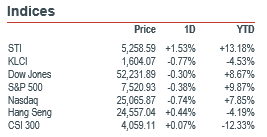
Market Movers: U.S. equities retreated on 10 November, with the S&P 500 falling 0.4% and the Nasdaq declining 0.7%, as hotter-than-expected inflation data pushed interest-rate expectations higher. Taiwan Semiconductor Manufacturing (TSM US) gained 2.0% after October revenue rose 59.7% YoY to NT$586.9bn, supporting the advanced-chip demand outlook. Hims & Hers Health (HIMS US) dropped 16.6% after results: fourth-quarter revenue guidance missed expectations and third-quarter gross margin fell to 57% from 74%, despite sales growth of 49%. Anthropic proposed an IPO of 825m shares at US$70–78 each, potentially raising US$64.35bn, alongside a separate US$26bn placement. The offering tests appetite for frontier AI exposure amid increasingly demanding funding requirements; proposed terms remain subject to final pricing. (Yahoo Finance / CNA) Taiwan Semiconductor Manufacturing (TSM US) is our Core Recommendation.
Macro: October US CPI rose 0.4% month on month versus 0.3% expected; core CPI rose 0.3% versus 0.2% expected. Before the release, Fed Governor Waller backed a 25bp December increase and said 50bp should be considered if core CPI reached 0.3%. No official YoY comparison was available because the prior-year shutdown disrupted data collection. (Reuters / Federal Reserve)
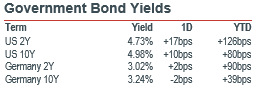
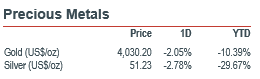
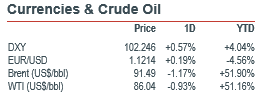
FICC: US two-year and ten-year Treasury yields rose 17bp and 10bp to 4.73% and 4.98%. Gold fell 2.0% to US$4,030.2/oz. Brent settled 1.20% lower at US$91.50/bbl after Secretary of State Rubio downplayed the need for further major combat against Iran. Tehran denied that negotiations were underway, leaving the shipping outlook uncertain despite reduced near-term escalation fears. (Reuters / eOption)
AI
• Anthropic tests investor appetite with a landmark fundraising. Anthropic proposed selling 825m shares at US$70–78 each, implying up to US$64.35bn in total IPO proceeds, alongside a separate US$26bn private placement. The proposed Nasdaq listing would test demand for frontier AI exposure as infrastructure commitments expand. Strategic backing strengthens funding capacity, although final pricing and successful completion remain uncertain. (Yahoo Finance)
• Google advances agentic security beyond conventional model benchmarks. Alphabet’s Google (GOOGL US) unveiled AlphaProof Code, using Gemini agents and human-reviewed specifications to verify key security properties of Signal’s compiled cryptographic code. The project generated over 6m lines of machine-checked proofs in four weeks. This strengthens the commercial case for specialised AI security tools, while verification remains limited to the specified properties. (Google DeepMind) Alphabet (GOOGL US) is our Core Recommendation.
• CoreWeave revenue strength confronts persistent funding concerns. CoreWeave (CRWV US) reported third-quarter revenue of US$3.66bn after the US close, up approximately 167.2% YoY and above US$3.55bn expected. Growth supports demand for specialist AI cloud capacity. However, debt exceeded US$50bn at June-end, leaving financing costs and the timing of cash generation central to assessing whether expansion creates sustainable shareholder value. (Reuters)
• Microsoft and IBM target regulated enterprise agent deployment. Microsoft (MSFT US) and IBM (IBM US) launched Imagine Enterprise, combining more than 6,000 prebuilt AI agents and assets with cloud, data and security tools. Initial frameworks cover financial services, insurance and retail, supported by engineers from both companies. The offering could accelerate enterprise adoption by addressing governance and integration barriers that constrain production deployments. (IBM) Microsoft (MSFT US) is our Investment Opportunity.
Americas
• Zeta rallies as stronger growth improves cash conversion. Zeta Global (ZETA US) gained about 8% after results showed revenue rising 46% YoY to US$493m. Growth excluding Marigold and political-candidate revenue reached 30%, while free cash flow rose 73% to US$82m. Higher full-year guidance reinforces operating momentum, with improving cash generation offering a firmer foundation for its enterprise AI ambitions. (Zeta Global / StockAnalysis)
• Hims selloff exposes weaker margins behind rapid growth. Hims & Hers Health (HIMS US) fell 16.6% after its results, as a US$875–895m fourth-quarter revenue forecast missed US$955.1m expected. Third-quarter sales rose 49% YoY to US$890.4m, but gross margin fell to 57% from 74%. The divergence highlights pressure on earnings conversion despite substantial growth in the business. (Hims & Hers / Yahoo Finance / StockAnalysis)
• Take-Two rallies as investors look beyond weaker bookings. Take-Two Interactive (TTWO US) rose 8.3% after its earnings release. Fiscal second-quarter net bookings fell 18% YoY to US$1.60bn, but management maintained its US$8.0–8.2bn annual outlook and highlighted record Grand Theft Auto VI preorders. The response underscores dependence on the approaching launch to translate franchise demand into stronger earnings. (Take-Two / StockAnalysis)
• Embraer upgrades its outlook as aerospace margins expand. Embraer (EMBJ US) raised its 2026 revenue forecast to US$8.4–8.6bn from US$8.2–8.5bn after third-quarter revenue rose 17% YoY to US$2.35bn. Adjusted operating margin improved to 10.9% from 8.6%, and annual adjusted free cash flow guidance excluding Eve increased to at least US$700m. Stronger services and defence activity support cash generation, although higher financing and tax costs constrained profit. (Embraer / Reuters)
• GFL rejects takeover offers and backs standalone growth. GFL Environmental (GFL US) ended its review of unsolicited takeover proposals, with the board unanimously choosing to remain public. Directors said offered premiums failed to reflect standalone value. Management expects free cash flow per share to double over five years and may pursue recurring buybacks, shifting investor focus from an immediate transaction towards execution and capital allocation. (GFL)
• Sanmina gains as integration lifts manufacturing growth expectations. Sanmina (SANM US) rose about 4% after its results. Fiscal 2026 revenue increased 79% to US$14.53bn as the group integrated ZT Systems and expanded cloud infrastructure exposure. Management forecast fiscal 2027 revenue of US$17.5–19.5bn, implying about 27% growth at midpoint. The outlook supports manufacturing demand while making successful integration increasingly important. (Sanmina / StockAnalysis)
• Beam advances sickle-cell therapy towards a regulatory filing. Beam Therapeutics (BEAM US) said its pivotal risto-cel trial met the primary endpoint of freedom from severe pain crises for at least 12 consecutive months, alongside all primary safety endpoints. Thirty-one patients had sufficient follow-up. A US filing could come by year-end, advancing base editing towards commercialisation, although detailed results and regulatory review remain outstanding. (Beam Therapeutics)
• TransDigm grows aircraft sales while financing dilutes earnings. TransDigm (TDG US) reported fiscal fourth-quarter sales of US$2.99bn, up 23% YoY, with organic growth of 14%. Adjusted EPS rose 15% to US$12.44, but net income fell 4% as interest and tax expenses increased. Management projected 14% sales growth at the fiscal 2027 guidance midpoint, supporting aerospace demand while highlighting the cost of leverage. (TransDigm)
• Household credit expands as delinquent balances increase. US household debt reached US$19.105tn in the third quarter, up US$334bn quarter on quarter and US$520bn from a year earlier. The New York Fed reported that 5.0% of outstanding debt was delinquent, up 0.3 percentage points. Mortgage credit quality remained strong overall, despite a modest deterioration in transitions into serious delinquency. (New York Fed)
Greater China
• TSMC reports record monthly revenue. Taiwan Semiconductor Manufacturing (TSM US) reported October sales of NT$586.89bn, up 59.7% YoY and 14.7% from September. January–October revenue rose 43.3% to NT$4.49tn. The acceleration provides a fresh operating check on semiconductor demand amid volatile AI valuations, although monthly sales alone do not establish margins or the profitability of customers’ infrastructure spending. (TSMC / CNA) Taiwan Semiconductor Manufacturing (TSM US) is our Core Recommendation.
• Alibaba opens a separate route for T-Head. Alibaba (9988.HK) disclosed that wholly owned chip subsidiary T-Head had confidentially applied for a Hong Kong listing after receiving exchange clearance. The application was submitted in September; offering size and ownership dilution remain undecided. A separate listing could improve valuation transparency and funding access, but approvals are outstanding and completion is not assured. (Alibaba filing) Alibaba (9988.HK) is our Core Recommendation.
• MiniMax broadens its image-generation offering. MiniMax (0100.HK) released H3-Image weights and related services, claiming 4K image generation in under ten seconds and support for sixteen reference images. Its shares separately gained 10.1% to HK$173.10. The release expands developer access to image editing and generation, but company-reported performance does not yet establish commercial adoption or sustainable unit economics. (MiniMax / Model card)
• WuXi sees a limited regulatory reprieve. WuXi AppTec (2359.HK) gained 1.20% to HK$200.40 in the first Hong Kong session after public notice of its removal from the Pentagon’s Chinese military-company list. The decision follows an August court injunction and allows possible relisting on additional grounds. The change reduces one legal obstacle, without resolving the wider policy risks facing Chinese research suppliers. (Federal Register)
• Hesai scales shipments while margins narrow. Hesai (HSAI US) reported Q3 revenue of RMB1.07bn, up 34.3% YoY, as lidar shipments increased 65.3% to 729,673 units. Gross margin slipped to 41.0% from 42.1%; net income fell 68.5% to RMB80.8m against a prior-year disposal gain. Rising volumes support its robotics strategy, but product mix and development spending still constrain earnings conversion. (Hesai / GlobeNewswire)
Asia ex. China
• SoftBank exposes AI infrastructure costs. SoftBank Group (9984 JP) reported a JPY1.1tn quarterly net loss versus JPY2.5tn profit a year earlier, including a US$3.7bn charge tied to revised US data-centre equipment plans. Financing costs more than doubled to JPY462bn. Shares rose 13.9% before results; the subsequent disclosure highlights procurement and funding risks rather than proving AI demand has weakened. (Reuters / SoftBank)
• Sea combines rapid growth with credit expansion. Singapore-based Sea (SE US) reported Q3 revenue of US$8.6bn, up 43.4% YoY, and net income of US$502.5m, up 34.0%. Shopee’s merchandise value increased 23.3%, while consumer and SME loans expanded 60.0%. Strong platform monetisation supports earnings, but the over-90-day overdue-loan ratio rose to 1.3% from 1.1%, making credit discipline increasingly important. (Sea / BusinessWire)
• KT looks to enterprise AI as telecom earnings ease. KT (030200 KS) reported Q3 revenue of KRW7.0tn, down 1.8% YoY, and operating profit of KRW505.3bn, down 6.1%. Wireless service revenue declined 3.9% following customer compensation and churn. Cumulative business-to-business and AI-transformation orders grew more than 20%, offering a potential offset, but investors need evidence that the backlog converts into profitable revenue. (Yonhap)
EMEA and Others
• Infineon targets stronger growth from power chips. Infineon (IFX GY) forecast FY2027 revenue of approximately EUR20bn, more than 20% growth, including nearly EUR4bn from data-centre power supplies. FY2026 revenue rose 12% to EUR16.35bn, while quarterly segment margin reached 23.8%. The outlook supports investment in power semiconductors, although planned EUR3.0bn–3.5bn spending increases the importance of converting demand into cash. (Infineon)
• Nexperia keeps reunification on the table. Nexperia’s interim chief executive said reunification with its Chinese operations remained possible, with fair compensation for parent Wingtech if separation became permanent. Excluding Chinese units, Q3 revenue was US$389m, up 9.3% sequentially, and operating cash flow reached US$55m. Production still falls short of demand, leaving automotive customers exposed to fragmented supply chains despite expanded Malaysian capacity. (Reuters)
Traders' Corner
Our Technical View
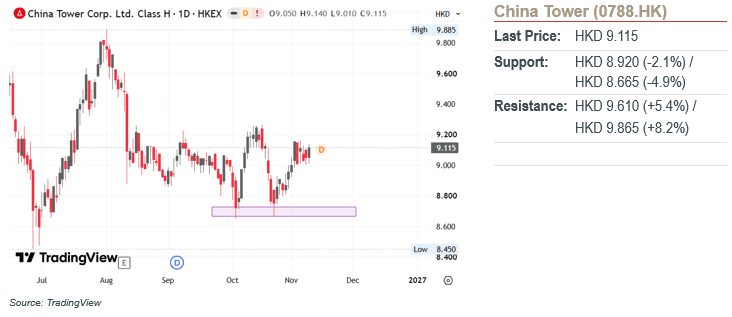
Price is consolidating into a potential pennant continuation pattern after rebounding from its prior swing low support zone.
The RSI is hovering and sloping upward above the 50 neutral baseline.
We could expect an upward breakout wave targeting higher structural resistance once price breaks above the pennant.
Our Technical View
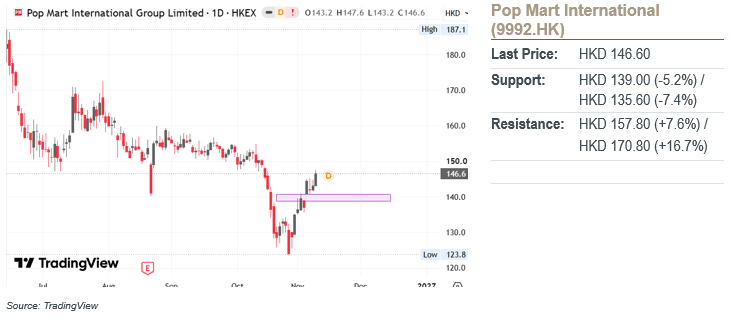
MiniMax Price successfully defended its position above the newly established gap-support baseline.
The RSI is sloping upward with positive velocity and remains firmly anchored above the 50 neutral baseline.
As long as price remains defended above the gap-support threshold, we see continued upward expansion toward upper resistance targets.
Market Movers: U.S. equities retreated on 10 November, with the S&P 500 falling 0.4% and the Nasdaq declining 0.7%, as hotter-than-expected inflation data pushed interest-rate expectations higher. Taiwan Semiconductor Manufacturing (TSM US) gained 2.0% after October revenue rose 59.7% YoY to NT$586.9bn, supporting the advanced-chip demand outlook. Hims & Hers Health (HIMS US) dropped 16.6% after results: fourth-quarter revenue guidance missed expectations and third-quarter gross margin fell to 57% from 74%, despite sales growth of 49%. Anthropic proposed an IPO of 825m shares at US$70–78 each, potentially raising US$64.35bn, alongside a separate US$26bn placement. The offering tests appetite for frontier AI exposure amid increasingly demanding funding requirements; proposed terms remain subject to final pricing. (Yahoo Finance / CNA) Taiwan Semiconductor Manufacturing (TSM US) is our Core Recommendation.
Macro: October US CPI rose 0.4% month on month versus 0.3% expected; core CPI rose 0.3% versus 0.2% expected. Before the release, Fed Governor Waller backed a 25bp December increase and said 50bp should be considered if core CPI reached 0.3%. No official YoY comparison was available because the prior-year shutdown disrupted data collection. (Reuters / Federal Reserve)
FICC: US two-year and ten-year Treasury yields rose 17bp and 10bp to 4.73% and 4.98%. Gold fell 2.0% to US$4,030.2/oz. Brent settled 1.20% lower at US$91.50/bbl after Secretary of State Rubio downplayed the need for further major combat against Iran. Tehran denied that negotiations were underway, leaving the shipping outlook uncertain despite reduced near-term escalation fears. (Reuters / eOption)
AI
• Anthropic tests investor appetite with a landmark fundraising. Anthropic proposed selling 825m shares at US$70–78 each, implying up to US$64.35bn in total IPO proceeds, alongside a separate US$26bn private placement. The proposed Nasdaq listing would test demand for frontier AI exposure as infrastructure commitments expand. Strategic backing strengthens funding capacity, although final pricing and successful completion remain uncertain. (Yahoo Finance)
• Google advances agentic security beyond conventional model benchmarks. Alphabet’s Google (GOOGL US) unveiled AlphaProof Code, using Gemini agents and human-reviewed specifications to verify key security properties of Signal’s compiled cryptographic code. The project generated over 6m lines of machine-checked proofs in four weeks. This strengthens the commercial case for specialised AI security tools, while verification remains limited to the specified properties. (Google DeepMind) Alphabet (GOOGL US) is our Core Recommendation.
• CoreWeave revenue strength confronts persistent funding concerns. CoreWeave (CRWV US) reported third-quarter revenue of US$3.66bn after the US close, up approximately 167.2% YoY and above US$3.55bn expected. Growth supports demand for specialist AI cloud capacity. However, debt exceeded US$50bn at June-end, leaving financing costs and the timing of cash generation central to assessing whether expansion creates sustainable shareholder value. (Reuters)
• Microsoft and IBM target regulated enterprise agent deployment. Microsoft (MSFT US) and IBM (IBM US) launched Imagine Enterprise, combining more than 6,000 prebuilt AI agents and assets with cloud, data and security tools. Initial frameworks cover financial services, insurance and retail, supported by engineers from both companies. The offering could accelerate enterprise adoption by addressing governance and integration barriers that constrain production deployments. (IBM) Microsoft (MSFT US) is our Investment Opportunity.
Americas
• Zeta rallies as stronger growth improves cash conversion. Zeta Global (ZETA US) gained about 8% after results showed revenue rising 46% YoY to US$493m. Growth excluding Marigold and political-candidate revenue reached 30%, while free cash flow rose 73% to US$82m. Higher full-year guidance reinforces operating momentum, with improving cash generation offering a firmer foundation for its enterprise AI ambitions. (Zeta Global / StockAnalysis)
• Hims selloff exposes weaker margins behind rapid growth. Hims & Hers Health (HIMS US) fell 16.6% after its results, as a US$875–895m fourth-quarter revenue forecast missed US$955.1m expected. Third-quarter sales rose 49% YoY to US$890.4m, but gross margin fell to 57% from 74%. The divergence highlights pressure on earnings conversion despite substantial growth in the business. (Hims & Hers / Yahoo Finance / StockAnalysis)
• Take-Two rallies as investors look beyond weaker bookings. Take-Two Interactive (TTWO US) rose 8.3% after its earnings release. Fiscal second-quarter net bookings fell 18% YoY to US$1.60bn, but management maintained its US$8.0–8.2bn annual outlook and highlighted record Grand Theft Auto VI preorders. The response underscores dependence on the approaching launch to translate franchise demand into stronger earnings. (Take-Two / StockAnalysis)
• Embraer upgrades its outlook as aerospace margins expand. Embraer (EMBJ US) raised its 2026 revenue forecast to US$8.4–8.6bn from US$8.2–8.5bn after third-quarter revenue rose 17% YoY to US$2.35bn. Adjusted operating margin improved to 10.9% from 8.6%, and annual adjusted free cash flow guidance excluding Eve increased to at least US$700m. Stronger services and defence activity support cash generation, although higher financing and tax costs constrained profit. (Embraer / Reuters)
• GFL rejects takeover offers and backs standalone growth. GFL Environmental (GFL US) ended its review of unsolicited takeover proposals, with the board unanimously choosing to remain public. Directors said offered premiums failed to reflect standalone value. Management expects free cash flow per share to double over five years and may pursue recurring buybacks, shifting investor focus from an immediate transaction towards execution and capital allocation. (GFL)
• Sanmina gains as integration lifts manufacturing growth expectations. Sanmina (SANM US) rose about 4% after its results. Fiscal 2026 revenue increased 79% to US$14.53bn as the group integrated ZT Systems and expanded cloud infrastructure exposure. Management forecast fiscal 2027 revenue of US$17.5–19.5bn, implying about 27% growth at midpoint. The outlook supports manufacturing demand while making successful integration increasingly important. (Sanmina / StockAnalysis)
• Beam advances sickle-cell therapy towards a regulatory filing. Beam Therapeutics (BEAM US) said its pivotal risto-cel trial met the primary endpoint of freedom from severe pain crises for at least 12 consecutive months, alongside all primary safety endpoints. Thirty-one patients had sufficient follow-up. A US filing could come by year-end, advancing base editing towards commercialisation, although detailed results and regulatory review remain outstanding. (Beam Therapeutics)
• TransDigm grows aircraft sales while financing dilutes earnings. TransDigm (TDG US) reported fiscal fourth-quarter sales of US$2.99bn, up 23% YoY, with organic growth of 14%. Adjusted EPS rose 15% to US$12.44, but net income fell 4% as interest and tax expenses increased. Management projected 14% sales growth at the fiscal 2027 guidance midpoint, supporting aerospace demand while highlighting the cost of leverage. (TransDigm)
• Household credit expands as delinquent balances increase. US household debt reached US$19.105tn in the third quarter, up US$334bn quarter on quarter and US$520bn from a year earlier. The New York Fed reported that 5.0% of outstanding debt was delinquent, up 0.3 percentage points. Mortgage credit quality remained strong overall, despite a modest deterioration in transitions into serious delinquency. (New York Fed)
Greater China
• TSMC reports record monthly revenue. Taiwan Semiconductor Manufacturing (TSM US) reported October sales of NT$586.89bn, up 59.7% YoY and 14.7% from September. January–October revenue rose 43.3% to NT$4.49tn. The acceleration provides a fresh operating check on semiconductor demand amid volatile AI valuations, although monthly sales alone do not establish margins or the profitability of customers’ infrastructure spending. (TSMC / CNA) Taiwan Semiconductor Manufacturing (TSM US) is our Core Recommendation.
• Alibaba opens a separate route for T-Head. Alibaba (9988.HK) disclosed that wholly owned chip subsidiary T-Head had confidentially applied for a Hong Kong listing after receiving exchange clearance. The application was submitted in September; offering size and ownership dilution remain undecided. A separate listing could improve valuation transparency and funding access, but approvals are outstanding and completion is not assured. (Alibaba filing) Alibaba (9988.HK) is our Core Recommendation.
• MiniMax broadens its image-generation offering. MiniMax (0100.HK) released H3-Image weights and related services, claiming 4K image generation in under ten seconds and support for sixteen reference images. Its shares separately gained 10.1% to HK$173.10. The release expands developer access to image editing and generation, but company-reported performance does not yet establish commercial adoption or sustainable unit economics. (MiniMax / Model card)
• WuXi sees a limited regulatory reprieve. WuXi AppTec (2359.HK) gained 1.20% to HK$200.40 in the first Hong Kong session after public notice of its removal from the Pentagon’s Chinese military-company list. The decision follows an August court injunction and allows possible relisting on additional grounds. The change reduces one legal obstacle, without resolving the wider policy risks facing Chinese research suppliers. (Federal Register)
• Hesai scales shipments while margins narrow. Hesai (HSAI US) reported Q3 revenue of RMB1.07bn, up 34.3% YoY, as lidar shipments increased 65.3% to 729,673 units. Gross margin slipped to 41.0% from 42.1%; net income fell 68.5% to RMB80.8m against a prior-year disposal gain. Rising volumes support its robotics strategy, but product mix and development spending still constrain earnings conversion. (Hesai / GlobeNewswire)
Asia ex. China
• SoftBank exposes AI infrastructure costs. SoftBank Group (9984 JP) reported a JPY1.1tn quarterly net loss versus JPY2.5tn profit a year earlier, including a US$3.7bn charge tied to revised US data-centre equipment plans. Financing costs more than doubled to JPY462bn. Shares rose 13.9% before results; the subsequent disclosure highlights procurement and funding risks rather than proving AI demand has weakened. (Reuters / SoftBank)
• Sea combines rapid growth with credit expansion. Singapore-based Sea (SE US) reported Q3 revenue of US$8.6bn, up 43.4% YoY, and net income of US$502.5m, up 34.0%. Shopee’s merchandise value increased 23.3%, while consumer and SME loans expanded 60.0%. Strong platform monetisation supports earnings, but the over-90-day overdue-loan ratio rose to 1.3% from 1.1%, making credit discipline increasingly important. (Sea / BusinessWire)
• KT looks to enterprise AI as telecom earnings ease. KT (030200 KS) reported Q3 revenue of KRW7.0tn, down 1.8% YoY, and operating profit of KRW505.3bn, down 6.1%. Wireless service revenue declined 3.9% following customer compensation and churn. Cumulative business-to-business and AI-transformation orders grew more than 20%, offering a potential offset, but investors need evidence that the backlog converts into profitable revenue. (Yonhap)
EMEA and Others
• Infineon targets stronger growth from power chips. Infineon (IFX GY) forecast FY2027 revenue of approximately EUR20bn, more than 20% growth, including nearly EUR4bn from data-centre power supplies. FY2026 revenue rose 12% to EUR16.35bn, while quarterly segment margin reached 23.8%. The outlook supports investment in power semiconductors, although planned EUR3.0bn–3.5bn spending increases the importance of converting demand into cash. (Infineon)
• Nexperia keeps reunification on the table. Nexperia’s interim chief executive said reunification with its Chinese operations remained possible, with fair compensation for parent Wingtech if separation became permanent. Excluding Chinese units, Q3 revenue was US$389m, up 9.3% sequentially, and operating cash flow reached US$55m. Production still falls short of demand, leaving automotive customers exposed to fragmented supply chains despite expanded Malaysian capacity. (Reuters)
Traders' Corner
Our Technical View
Price is consolidating into a potential pennant continuation pattern after rebounding from its prior swing low support zone.
The RSI is hovering and sloping upward above the 50 neutral baseline.
We could expect an upward breakout wave targeting higher structural resistance once price breaks above the pennant.
Our Technical View
MiniMax Price successfully defended its position above the newly established gap-support baseline.
The RSI is sloping upward with positive velocity and remains firmly anchored above the 50 neutral baseline.
As long as price remains defended above the gap-support threshold, we see continued upward expansion toward upper resistance targets.
Disclosures and disclaimers
This report is provided subject to, and must be read together with, the full Disclosures / Disclaimers available at this link, which are incorporated by reference into this report. In particular, this report is intended for general circulation and informational purposes only and does not constitute personal investment advice or a recommendation to buy or sell any investment product or security. You should independently evaluate the information and, where necessary, seek advice from a qualified financial adviser regarding the suitability of any investment. Analyst certifications required under applicable regulations, including SEC Regulation AC (where relevant), are included in this report. By accessing, receiving or using this report, you acknowledge that you have read, understood and agreed to be bound by the Disclosures / Disclaimers, as may be amended, supplemented or updated from time to time.


