

Wealth Daily
AI Shares Slide as Earnings and Policy Risks Mount
Today’s Must-Know News
Overnight Markets
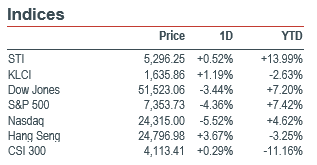
Market Movers: US equities slumped on 5 November, with the S&P 500 and Nasdaq falling 4.36% and 5.52%, respectively, as a semiconductor sell-off intensified. Nvidia (NVDA US) lost 9.26%; Reuters reported 600,000 H200 chips in Hong Kong awaiting Chinese import approval. SK Hynix (000660.KS) fell 9.46% amid investor concerns about US data-centre spending after the election. Micron Technology (MU US) dropped 17.46% as Bloomberg reported a US$4.5bn Taiwan plant pause. Policy uncertainty and project execution are testing the durability of AI investment. Reuters also newly disclosed that Microsoft (MSFT US) had declined a Texas expansion option months earlier; its existing Nscale contract remains intact. (AP/ Reuters / Reuters / Aju Press / Reuters) Nvidia (NVDA US) and Microsoft (MSFT US) are our Core Recommendations; SK Hynix (SKHY US) and Micron Technology (MU US) are our Investment Opportunities.
Macro: The Bank of England raised Bank Rate 25bps to 4.0% by an 8–1 vote; the dissenter preferred 50bps. September inflation was 3.5%. It projects inflation near 5% by mid-2027 as energy costs feed through, while stressing policy is not preset. The decision highlights renewed inflation risk despite a still-restrictive policy stance. (BoE)
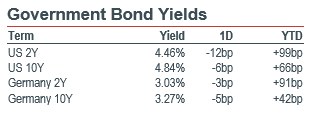
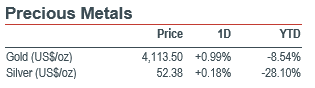
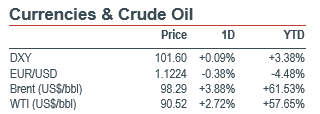
FICC: January Brent settled 3.88% higher at US$98.29/bbl and December WTI rose 2.72% to US$90.52/bbl as Iran-war uncertainty returned to focus. The US 10-year yield fell 6bps to 4.84% and the 2-year yield fell 12bps to 4.46%. Higher oil alongside lower yields leaves portfolios exposed to both inflation and growth risks. December gold futures settled at US$4,113.50/oz, up 0.99%. A live 05:51:36 SGT snapshot put DXY at 101.60. (Reuters / US Treasury / eOption / Yahoo Finance)
AI
• Nvidia chips pile up awaiting China approvals. Nvidia (NVDA US) fell about 9.3% during Thursday's AI selloff. Reuters separately reported that about 600,000 H200 chips were held in Hong Kong awaiting mainland import approval, citing two sources. Strong Chinese demand therefore does not guarantee near-term deliveries; regulatory clearance remains a constraint on converting inventory into sales. (Reuters) Nvidia (NVDA US) is our Core Recommendation.
• Microsoft scrutinises data-centre expansion. Microsoft (MSFT US) fell about 3.6%. Reuters newly disclosed that it had declined an option to more than double its Texas capacity agreement with Nscale. The decision was made several months ago and the existing contract remains intact. The distinction matters: additional capacity is being scrutinised, rather than the contracted project being cancelled. (Reuters) Microsoft (MSFT US) is our Core Recommendation.
• OpenAI limits access to its new cybersecurity model. OpenAI released GPT-6 Cyber to selected Daybreak Red defenders, initially through the API and Codex. It reported 81 previously unknown high-severity Firefox vulnerabilities in its testing and assigned a Critical cybersecurity rating. Restricted access balances faster defensive cybersecurity research against attacker misuse; broad availability remains unannounced. (OpenAI / Reuters)
• Report of Micron’s Taiwan plant pause deepens memory rout. Micron Technology (MU US) fell about 17.5%. Reuters relayed Bloomberg's report that work on a US$4.5bn Taiwan plant had paused amid a labour dispute, without independently verifying it. Micron said existing operations continued normally. The reported disruption concerns future capacity, adding execution uncertainty to the broader memory-stock selloff rather than establishing an immediate production shutdown. (Reuters / Tom's Hardware) Micron Technology (MU US) is our Investment Opportunity.
Americas
• Tesla slides as midterm results sharpen regulatory concerns. Tesla (TSLA US) fell sharply as investors reassessed potential scrutiny of Elon Musk's businesses after the US midterms. Reuters highlighted risks to data-centre construction and a possible SpaceX combination. The previously proposed Texas chip complex could cost up to US$119bn. These are execution and political risks to future plans; no new construction ban or completed merger was announced. (Reuters)
• Amazon brings Uber Eats delivery into Prime. Amazon (AMZN US) added nationwide Uber Eats ordering to its website and app. Prime members get US$0 delivery fees on restaurant orders of at least US$25, without another Uber account; service fees remain. Prime engagement could improve; terms and incremental earnings remain undisclosed. (Amazon / The Next Web) Amazon (AMZN US) is our Core Recommendation.
• Eli Lilly advances a combination treatment. Eli Lilly (LLY US) released 52-week Taltz-plus-Zepbound data for adults with psoriatic arthritis and obesity. ACR50 responses reached 43.7% versus 15.7% with Taltz alone. The findings support evaluating metabolic and inflammatory disease together; they represent research results, not regulatory approval. (Lilly) Eli Lilly (LLY US) is our Core Recommendation.
• Walmart expands drone delivery. Walmart (WMT US) plans 300 additional Zipline drone-delivery sites nationwide under a multi-year agreement. Its broader programme has completed over 2 million deliveries, with eligible essentials arriving in as little as 30 minutes. Economics could improve; deployment costs, timing and incremental profit remain unquantified. (Walmart) Walmart (WMT US) is our Core Recommendation.
• Qualcomm’s handset weakness overwhelms diversification. Qualcomm (QCOM US) fell approximately 9.5% on Thursday as investors reacted to its results released on Wednesday. Quarterly handset revenue fell 26% to US$5.14bn, while automotive revenue rose 89% to US$1.99bn. Management reiterated a US$5bn fiscal-2027 data-center revenue target. The contrast shows why diversification is strategically useful but cannot yet offset weakness in its largest end-market. (Qualcomm / Reuters)
• AppLovin’s advertising results buck the selloff of technology. AppLovin (APP US) rose about 31.0% in Thursday's completed reaction to Wednesday's results. 3Q26 revenue increased 55% to US$2.18bn and diluted EPS reached US$4.30. Fourth-quarter revenue guidance was US$2.365bn–US$2.395bn. Stronger monetisation distinguishes this operating performance from the wider AI-infrastructure retreat, although sustaining growth as the new advertising models scale remains the next test. (AppLovin / AP)
Greater China
• Tencent extends its rally after Hy4 launch. Tencent (0700.HK) advanced approximately 7.2% following the previous day’s Hy4 release. The model adds visual understanding and computer-use capabilities; weights are still due to be released. Shares have risen for five sessions. Better product capability broadens Tencent’s enterprise opportunity, but commercial uptake must justify the group’s substantial AI infrastructure investment. (Securities Times / Reuters) Tencent (0700.HK) is our Core Recommendation.
• Alibaba gains as Qwen expands office editing. Alibaba (9988.HK) rose approximately 8.4% as Hong Kong technology shares rallied. Separately, Qwen upgraded in-app editing and custom templates for Word, Excel and PowerPoint on Thursday, with access being rolled out gradually. Users can retain layouts and edit selected content instead of regenerating entire files. The upgrade targets recurring office workflows, although adoption and monetisation have not been quantified. (Reuters / AIbase) Alibaba (9988.HK) is our Core Recommendation.
• Taiwan chips remain under selling pressure. TSMC’s Taiwan shares (2330.TW) fell 0.88% as the TAIEX declined approximately 3.2% for a sixth consecutive losing session. Selling concentrated in electronics and the AI supply chain, while traditional industries and financials were more resilient. The divergence highlights valuation and capital-spending sensitivity across suppliers; it does not establish a newly announced TSMC earnings downgrade or a change in the company’s guidance. (China News Service) TSMC’s US ADR (TSM US) is our Core Recommendation.
• CATL joins the battery-sector rebound. CATL’s A shares (300750.SZ) rose approximately 4.4% as battery stocks rebounded. Lithium carbonate futures rose more than 5% intraday to RMB93,260 per tonne. Stronger lithium sentiment supports materials producers but can raise cell manufacturers’ input costs. Order volumes, contract repricing and cost pass-through will determine whether the rally translates into earnings. (Securities Times / Caiwen) CATL (300750.SZ) is our Core Recommendation.
• Trip.com rallies with the autumn travel trade. Trip.com (9961.HK) gained approximately 8.2% as travel shares strengthened. Local school autumn holidays created five-day travel windows in early to mid-November. Gelonghui cited Meituan data showing early-November Beijing attraction bookings at about twice the year-earlier level. This is sector demand evidence, not Trip.com guidance; profitability still depends on converting traffic into bookings. (Gelonghui) Trip.com (9961.HK) is our Core Recommendation.
• Baidu releases a base model for further training. Baidu (9888.HK) released ERNIE 5.5 Flash Base with 280bn total parameters and 14bn activated per token. The company says it supports one-million-token contexts for fine-tuning and inference. These are pre-training weights; a post-trained model will follow. The release gives developers a starting point for specialist adaptation, while further training, deployment cost and commercial licensing still determine practical adoption. (Company / IT Home)
Asia ex. China
• SK Hynix and Samsung price in data-center uncertainty. SK Hynix (000660.KS) dropped approximately 9.5% and Samsung Electronics (005930.KS) approximately 7.6% in Thursday’s completed session. Investors worried that US election results could bring tighter data-centre rules and slower AI infrastructure spending. These remain policy risks, rather than enacted restrictions. The selloff raises the importance of customer commitments and funding visibility for memory suppliers after their substantial capacity investment. (Aju Press / StockAnalysis) SK Hynix (SKHY US) is our Investment Opportunity.
• Toyota pairs stronger guidance with substantial capital returns. Toyota (7203.T) climbed approximately 16.7% after lifting its annual operating-profit forecast by 15% to JPY3.9tn and outlining up to JPY14tn of shareholder returns through March 2031. July–September operating profit rose 34%, helped by hybrid demand. The capital-return plan is twice the preceding five-year amount, supporting the equity case while preserving a substantial commitment to research and capital investment. (Company / Reuters)
• NAB faces a harsher credit-cost outlook. National Australia Bank (NAB.AX) fell approximately 5.40% in Thursday’s completed session after its earlier annual results. Cash earnings fell 13.4% to A$6.14bn; excluding large notable items, they were flat at A$7.09bn. Credit impairment charges increased to A$1.55bn from A$833m. Higher provisions and slowing economic growth can absorb otherwise stronger underlying revenue and margin performance. (Company / Capital Brief)
• Sony upgrades its outlook after an earnings beat. Sony (6758.T) reported quarterly operating profit of JPY622.3bn, up 45% and above the JPY505bn consensus cited by Reuters. It raised its FY26 profit outlook by 9%, supported by films, music and image sensors. PlayStation 5 shipments fell to 2.6m from 4m. Results came after the close, so the preceding share-price rise cannot be attributed to this earnings release. (Company / Reuters)
• DBS trading weakness offsets wealth growth. DBS (D05.SI) reported quarterly net profit of S$2.81bn, down 5% and below the S$2.90bn consensus. Markets trading income fell 65% to S$152m, while wealth-management fees rose 9% to S$864m. Net interest margin narrowed nine basis points year on year to 1.87%. Diversified fee growth provides support, but the earnings miss exposes sensitivity to market volatility despite strong customer-franchise expansion. (Company / Reuters)
• Mahindra auto growth offsets weaker farming profits. Mahindra & Mahindra (M&M.NS) reported consolidated profit after non-controlling interests of INR45.88bn, up 25%, on revenue of INR575.53bn, also up 25%. SUV volumes increased 26%, while farm-segment revenue fell 6% and its profit fell 9%. Automotive demand is carrying the group, but the divergence leaves earnings sensitive to vehicle mix, commodity costs and recovery in agricultural equipment demand. (Company / CNBC-TV18)
EMEA and Others
• Rheinmetall guidance reset exposes delivery risk. Rheinmetall (RHM.DE) fell 16.14% to €841.50 in the first session after the earlier guidance cut. The company now targets €13.2bn of 2026 sales and an 18.5% operating margin, as Arminius vehicle orders and ammunition approvals slip. New quarterly results showed €553m operating profit but negative operating free cash flow. Backlog conversion, rather than defense demand alone, is the immediate earnings test. (Rheinmetall / Reuters)
• Deutsche Telekom pairs stronger earnings with larger distributions. Deutsche Telekom (DTE.DE) reported 8.0% organic growth in 3Q26 adjusted EBITDA after leases to €12.2bn. The group raised its FY26 target to €47.6bn from €47.50bn and free-cash-flow guidance to €20.1bn from €20.0bn. Management proposed a 10% dividend increase to €1.10 and up to €2bn of 2027 buybacks. T-Mobile US momentum supports distributions; the forecast increases themselves remain modest. (Deutsche Telekom)
• Legrand upgrades growth targets on data-centre demand. Legrand (LR.PA) reported nine-month sales of €8.33bn, up 19.5%, including 12.7% organic growth; data-centre organic sales expanded nearly 40%. Management lifted its FY26 organic growth target to 11%–13% from 8%–10%, while retaining the 20.5%–21.0% adjusted operating-margin target. The figures support sustained electrical-infrastructure demand, although unchanged margin guidance cautions against assuming revenue upgrades translate proportionately into profit. (Legrand)
• Healthineers’ new outlook tempers a strong imaging quarter. Siemens Healthineers (SHL.DE) reported 4QFY26 comparable revenue growth of 5.9%, led by 10.0% growth in Imaging, while Diagnostics contracted 4.2%. The company targets 4%–5% comparable growth in fiscal 2027 and adjusted EPS of €2.20–2.40, below fiscal 2026’s €2.42. A planned Diagnostics carve-out adds execution considerations. Strong equipment demand therefore coexists with a weaker forward earnings range and a proposed unchanged €1.00 dividend. (Siemens Healthineers)
• Commerzbank’s profit rise masks pressure on deposit margins. Commerzbank (CBK.DE) reported 3Q26 net profit growth of 45% to €859m, with fee income up 8.8% and net interest income up 3.5%. The bank lowered FY26 net-interest-income guidance to €8.5bn from €8.6bn amid deposit competition, but retained its at-least-€3.4bn net-profit target and €3.2bn capital-return plan. Fee diversification supports earnings, while pricing discipline remains central to sustaining returns. (Commerzbank)
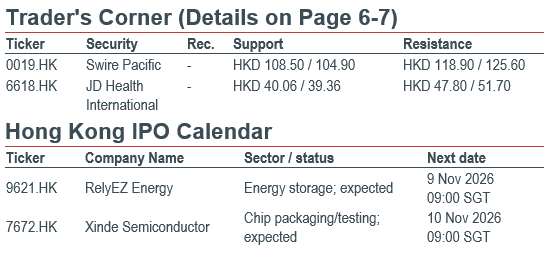
Traders' Corner
Our Technical View
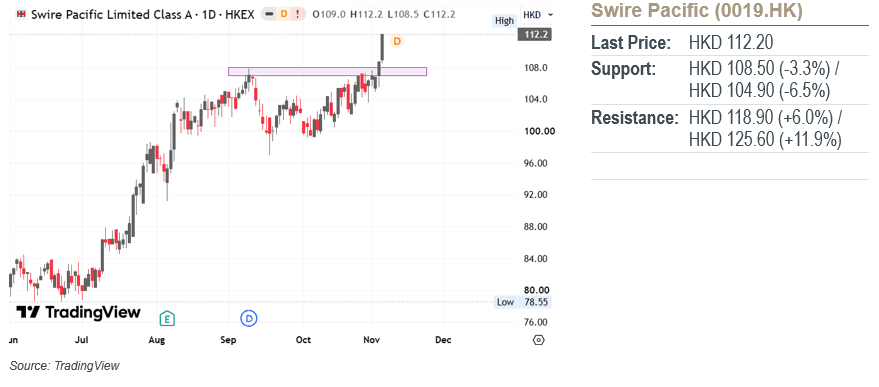
Price penetrated its prior swing high resistance to establish a fresh all-time high.
By clearing all historical overhead supply boundaries, price enters price discovery mode.
The RSI is bullish and sloping upward with high positive velocity toward overbought parameters.
As long as price remains defended above the resistance-turned-support baseline, we see continued upward expansion toward measured move projection targets.
Our Technical View
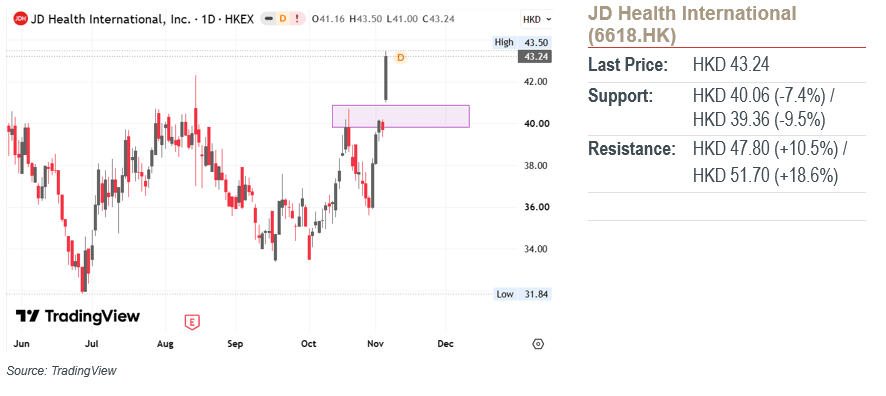
At Price penetrated its previous peak via a powerful gap-up yesterday.
This action bypasses immediate overhead supply boundaries.
The RSI remains firmly anchored in strong bullish territory and is occupying the overbought zone.
As long as price remains defended above the newly gap-support, we see continued upward expansion toward higher resistance.
Market Movers: US equities slumped on 5 November, with the S&P 500 and Nasdaq falling 4.36% and 5.52%, respectively, as a semiconductor sell-off intensified. Nvidia (NVDA US) lost 9.26%; Reuters reported 600,000 H200 chips in Hong Kong awaiting Chinese import approval. SK Hynix (000660.KS) fell 9.46% amid investor concerns about US data-centre spending after the election. Micron Technology (MU US) dropped 17.46% as Bloomberg reported a US$4.5bn Taiwan plant pause. Policy uncertainty and project execution are testing the durability of AI investment. Reuters also newly disclosed that Microsoft (MSFT US) had declined a Texas expansion option months earlier; its existing Nscale contract remains intact. (AP/ Reuters / Reuters / Aju Press / Reuters) Nvidia (NVDA US) and Microsoft (MSFT US) are our Core Recommendations; SK Hynix (SKHY US) and Micron Technology (MU US) are our Investment Opportunities.
Macro: The Bank of England raised Bank Rate 25bps to 4.0% by an 8–1 vote; the dissenter preferred 50bps. September inflation was 3.5%. It projects inflation near 5% by mid-2027 as energy costs feed through, while stressing policy is not preset. The decision highlights renewed inflation risk despite a still-restrictive policy stance. (BoE)
FICC: January Brent settled 3.88% higher at US$98.29/bbl and December WTI rose 2.72% to US$90.52/bbl as Iran-war uncertainty returned to focus. The US 10-year yield fell 6bps to 4.84% and the 2-year yield fell 12bps to 4.46%. Higher oil alongside lower yields leaves portfolios exposed to both inflation and growth risks. December gold futures settled at US$4,113.50/oz, up 0.99%. A live 05:51:36 SGT snapshot put DXY at 101.60. (Reuters / US Treasury / eOption / Yahoo Finance)
AI
• Nvidia chips pile up awaiting China approvals. Nvidia (NVDA US) fell about 9.3% during Thursday's AI selloff. Reuters separately reported that about 600,000 H200 chips were held in Hong Kong awaiting mainland import approval, citing two sources. Strong Chinese demand therefore does not guarantee near-term deliveries; regulatory clearance remains a constraint on converting inventory into sales. (Reuters) Nvidia (NVDA US) is our Core Recommendation.
• Microsoft scrutinises data-centre expansion. Microsoft (MSFT US) fell about 3.6%. Reuters newly disclosed that it had declined an option to more than double its Texas capacity agreement with Nscale. The decision was made several months ago and the existing contract remains intact. The distinction matters: additional capacity is being scrutinised, rather than the contracted project being cancelled. (Reuters) Microsoft (MSFT US) is our Core Recommendation.
• OpenAI limits access to its new cybersecurity model. OpenAI released GPT-6 Cyber to selected Daybreak Red defenders, initially through the API and Codex. It reported 81 previously unknown high-severity Firefox vulnerabilities in its testing and assigned a Critical cybersecurity rating. Restricted access balances faster defensive cybersecurity research against attacker misuse; broad availability remains unannounced. (OpenAI / Reuters)
• Report of Micron’s Taiwan plant pause deepens memory rout. Micron Technology (MU US) fell about 17.5%. Reuters relayed Bloomberg's report that work on a US$4.5bn Taiwan plant had paused amid a labour dispute, without independently verifying it. Micron said existing operations continued normally. The reported disruption concerns future capacity, adding execution uncertainty to the broader memory-stock selloff rather than establishing an immediate production shutdown. (Reuters / Tom's Hardware) Micron Technology (MU US) is our Investment Opportunity.
Americas
• Tesla slides as midterm results sharpen regulatory concerns. Tesla (TSLA US) fell sharply as investors reassessed potential scrutiny of Elon Musk's businesses after the US midterms. Reuters highlighted risks to data-centre construction and a possible SpaceX combination. The previously proposed Texas chip complex could cost up to US$119bn. These are execution and political risks to future plans; no new construction ban or completed merger was announced. (Reuters)
• Amazon brings Uber Eats delivery into Prime. Amazon (AMZN US) added nationwide Uber Eats ordering to its website and app. Prime members get US$0 delivery fees on restaurant orders of at least US$25, without another Uber account; service fees remain. Prime engagement could improve; terms and incremental earnings remain undisclosed. (Amazon / The Next Web) Amazon (AMZN US) is our Core Recommendation.
• Eli Lilly advances a combination treatment. Eli Lilly (LLY US) released 52-week Taltz-plus-Zepbound data for adults with psoriatic arthritis and obesity. ACR50 responses reached 43.7% versus 15.7% with Taltz alone. The findings support evaluating metabolic and inflammatory disease together; they represent research results, not regulatory approval. (Lilly) Eli Lilly (LLY US) is our Core Recommendation.
• Walmart expands drone delivery. Walmart (WMT US) plans 300 additional Zipline drone-delivery sites nationwide under a multi-year agreement. Its broader programme has completed over 2 million deliveries, with eligible essentials arriving in as little as 30 minutes. Economics could improve; deployment costs, timing and incremental profit remain unquantified. (Walmart) Walmart (WMT US) is our Core Recommendation.
• Qualcomm’s handset weakness overwhelms diversification. Qualcomm (QCOM US) fell approximately 9.5% on Thursday as investors reacted to its results released on Wednesday. Quarterly handset revenue fell 26% to US$5.14bn, while automotive revenue rose 89% to US$1.99bn. Management reiterated a US$5bn fiscal-2027 data-center revenue target. The contrast shows why diversification is strategically useful but cannot yet offset weakness in its largest end-market. (Qualcomm / Reuters)
• AppLovin’s advertising results buck the selloff of technology. AppLovin (APP US) rose about 31.0% in Thursday's completed reaction to Wednesday's results. 3Q26 revenue increased 55% to US$2.18bn and diluted EPS reached US$4.30. Fourth-quarter revenue guidance was US$2.365bn–US$2.395bn. Stronger monetisation distinguishes this operating performance from the wider AI-infrastructure retreat, although sustaining growth as the new advertising models scale remains the next test. (AppLovin / AP)
Greater China
• Tencent extends its rally after Hy4 launch. Tencent (0700.HK) advanced approximately 7.2% following the previous day’s Hy4 release. The model adds visual understanding and computer-use capabilities; weights are still due to be released. Shares have risen for five sessions. Better product capability broadens Tencent’s enterprise opportunity, but commercial uptake must justify the group’s substantial AI infrastructure investment. (Securities Times / Reuters) Tencent (0700.HK) is our Core Recommendation.
• Alibaba gains as Qwen expands office editing. Alibaba (9988.HK) rose approximately 8.4% as Hong Kong technology shares rallied. Separately, Qwen upgraded in-app editing and custom templates for Word, Excel and PowerPoint on Thursday, with access being rolled out gradually. Users can retain layouts and edit selected content instead of regenerating entire files. The upgrade targets recurring office workflows, although adoption and monetisation have not been quantified. (Reuters / AIbase) Alibaba (9988.HK) is our Core Recommendation.
• Taiwan chips remain under selling pressure. TSMC’s Taiwan shares (2330.TW) fell 0.88% as the TAIEX declined approximately 3.2% for a sixth consecutive losing session. Selling concentrated in electronics and the AI supply chain, while traditional industries and financials were more resilient. The divergence highlights valuation and capital-spending sensitivity across suppliers; it does not establish a newly announced TSMC earnings downgrade or a change in the company’s guidance. (China News Service) TSMC’s US ADR (TSM US) is our Core Recommendation.
• CATL joins the battery-sector rebound. CATL’s A shares (300750.SZ) rose approximately 4.4% as battery stocks rebounded. Lithium carbonate futures rose more than 5% intraday to RMB93,260 per tonne. Stronger lithium sentiment supports materials producers but can raise cell manufacturers’ input costs. Order volumes, contract repricing and cost pass-through will determine whether the rally translates into earnings. (Securities Times / Caiwen) CATL (300750.SZ) is our Core Recommendation.
• Trip.com rallies with the autumn travel trade. Trip.com (9961.HK) gained approximately 8.2% as travel shares strengthened. Local school autumn holidays created five-day travel windows in early to mid-November. Gelonghui cited Meituan data showing early-November Beijing attraction bookings at about twice the year-earlier level. This is sector demand evidence, not Trip.com guidance; profitability still depends on converting traffic into bookings. (Gelonghui) Trip.com (9961.HK) is our Core Recommendation.
• Baidu releases a base model for further training. Baidu (9888.HK) released ERNIE 5.5 Flash Base with 280bn total parameters and 14bn activated per token. The company says it supports one-million-token contexts for fine-tuning and inference. These are pre-training weights; a post-trained model will follow. The release gives developers a starting point for specialist adaptation, while further training, deployment cost and commercial licensing still determine practical adoption. (Company / IT Home)
Asia ex. China
• SK Hynix and Samsung price in data-center uncertainty. SK Hynix (000660.KS) dropped approximately 9.5% and Samsung Electronics (005930.KS) approximately 7.6% in Thursday’s completed session. Investors worried that US election results could bring tighter data-centre rules and slower AI infrastructure spending. These remain policy risks, rather than enacted restrictions. The selloff raises the importance of customer commitments and funding visibility for memory suppliers after their substantial capacity investment. (Aju Press / StockAnalysis) SK Hynix (SKHY US) is our Investment Opportunity.
• Toyota pairs stronger guidance with substantial capital returns. Toyota (7203.T) climbed approximately 16.7% after lifting its annual operating-profit forecast by 15% to JPY3.9tn and outlining up to JPY14tn of shareholder returns through March 2031. July–September operating profit rose 34%, helped by hybrid demand. The capital-return plan is twice the preceding five-year amount, supporting the equity case while preserving a substantial commitment to research and capital investment. (Company / Reuters)
• NAB faces a harsher credit-cost outlook. National Australia Bank (NAB.AX) fell approximately 5.40% in Thursday’s completed session after its earlier annual results. Cash earnings fell 13.4% to A$6.14bn; excluding large notable items, they were flat at A$7.09bn. Credit impairment charges increased to A$1.55bn from A$833m. Higher provisions and slowing economic growth can absorb otherwise stronger underlying revenue and margin performance. (Company / Capital Brief)
• Sony upgrades its outlook after an earnings beat. Sony (6758.T) reported quarterly operating profit of JPY622.3bn, up 45% and above the JPY505bn consensus cited by Reuters. It raised its FY26 profit outlook by 9%, supported by films, music and image sensors. PlayStation 5 shipments fell to 2.6m from 4m. Results came after the close, so the preceding share-price rise cannot be attributed to this earnings release. (Company / Reuters)
• DBS trading weakness offsets wealth growth. DBS (D05.SI) reported quarterly net profit of S$2.81bn, down 5% and below the S$2.90bn consensus. Markets trading income fell 65% to S$152m, while wealth-management fees rose 9% to S$864m. Net interest margin narrowed nine basis points year on year to 1.87%. Diversified fee growth provides support, but the earnings miss exposes sensitivity to market volatility despite strong customer-franchise expansion. (Company / Reuters)
• Mahindra auto growth offsets weaker farming profits. Mahindra & Mahindra (M&M.NS) reported consolidated profit after non-controlling interests of INR45.88bn, up 25%, on revenue of INR575.53bn, also up 25%. SUV volumes increased 26%, while farm-segment revenue fell 6% and its profit fell 9%. Automotive demand is carrying the group, but the divergence leaves earnings sensitive to vehicle mix, commodity costs and recovery in agricultural equipment demand. (Company / CNBC-TV18)
EMEA and Others
• Rheinmetall guidance reset exposes delivery risk. Rheinmetall (RHM.DE) fell 16.14% to €841.50 in the first session after the earlier guidance cut. The company now targets €13.2bn of 2026 sales and an 18.5% operating margin, as Arminius vehicle orders and ammunition approvals slip. New quarterly results showed €553m operating profit but negative operating free cash flow. Backlog conversion, rather than defense demand alone, is the immediate earnings test. (Rheinmetall / Reuters)
• Deutsche Telekom pairs stronger earnings with larger distributions. Deutsche Telekom (DTE.DE) reported 8.0% organic growth in 3Q26 adjusted EBITDA after leases to €12.2bn. The group raised its FY26 target to €47.6bn from €47.50bn and free-cash-flow guidance to €20.1bn from €20.0bn. Management proposed a 10% dividend increase to €1.10 and up to €2bn of 2027 buybacks. T-Mobile US momentum supports distributions; the forecast increases themselves remain modest. (Deutsche Telekom)
• Legrand upgrades growth targets on data-centre demand. Legrand (LR.PA) reported nine-month sales of €8.33bn, up 19.5%, including 12.7% organic growth; data-centre organic sales expanded nearly 40%. Management lifted its FY26 organic growth target to 11%–13% from 8%–10%, while retaining the 20.5%–21.0% adjusted operating-margin target. The figures support sustained electrical-infrastructure demand, although unchanged margin guidance cautions against assuming revenue upgrades translate proportionately into profit. (Legrand)
• Healthineers’ new outlook tempers a strong imaging quarter. Siemens Healthineers (SHL.DE) reported 4QFY26 comparable revenue growth of 5.9%, led by 10.0% growth in Imaging, while Diagnostics contracted 4.2%. The company targets 4%–5% comparable growth in fiscal 2027 and adjusted EPS of €2.20–2.40, below fiscal 2026’s €2.42. A planned Diagnostics carve-out adds execution considerations. Strong equipment demand therefore coexists with a weaker forward earnings range and a proposed unchanged €1.00 dividend. (Siemens Healthineers)
• Commerzbank’s profit rise masks pressure on deposit margins. Commerzbank (CBK.DE) reported 3Q26 net profit growth of 45% to €859m, with fee income up 8.8% and net interest income up 3.5%. The bank lowered FY26 net-interest-income guidance to €8.5bn from €8.6bn amid deposit competition, but retained its at-least-€3.4bn net-profit target and €3.2bn capital-return plan. Fee diversification supports earnings, while pricing discipline remains central to sustaining returns. (Commerzbank)
Traders' Corner
Our Technical View
Price penetrated its prior swing high resistance to establish a fresh all-time high.
By clearing all historical overhead supply boundaries, price enters price discovery mode.
The RSI is bullish and sloping upward with high positive velocity toward overbought parameters.
As long as price remains defended above the resistance-turned-support baseline, we see continued upward expansion toward measured move projection targets.
Our Technical View
At Price penetrated its previous peak via a powerful gap-up yesterday.
This action bypasses immediate overhead supply boundaries.
The RSI remains firmly anchored in strong bullish territory and is occupying the overbought zone.
As long as price remains defended above the newly gap-support, we see continued upward expansion toward higher resistance.
Disclosures and disclaimers
This report is provided subject to, and must be read together with, the full Disclosures / Disclaimers available at this link, which are incorporated by reference into this report. In particular, this report is intended for general circulation and informational purposes only and does not constitute personal investment advice or a recommendation to buy or sell any investment product or security. You should independently evaluate the information and, where necessary, seek advice from a qualified financial adviser regarding the suitability of any investment. Analyst certifications required under applicable regulations, including SEC Regulation AC (where relevant), are included in this report. By accessing, receiving or using this report, you acknowledge that you have read, understood and agreed to be bound by the Disclosures / Disclaimers, as may be amended, supplemented or updated from time to time.


