

The 2026-2027 El Niño is shaping up to be a generational weather event, not only posing major economic risks but also spurring a wave of hedge fund trades. Read on to gauge the climate-driven risks into 2027 and what we can learn from how the smart money is positioning.
CIO Summary
- Generational climate shock fractures global supply chains. Record Pacific temperatures are triggering severe droughts and freak storms, creating acute bottlenecks from the Panama Canal to Southeast Asian agriculture.
- More persistent agri-inflation to slow global disinflation. Unlike fast-moving oil shocks, crop and freight disruptions will likely act as a lingering macro headwind, slowing global disinflation and disproportionately squeezing Emerging Market purchasing power.
- Follow the smart money via ETFs. Institutional "smart money" is actively leveraging climate-induced mispricings to generate alpha in commodities. Their strategies are not easily replicable by individual investors, but agriculture-related ETFs can provide more accessible and transparent exposure to the underlying theme, albeit with higher volatility.
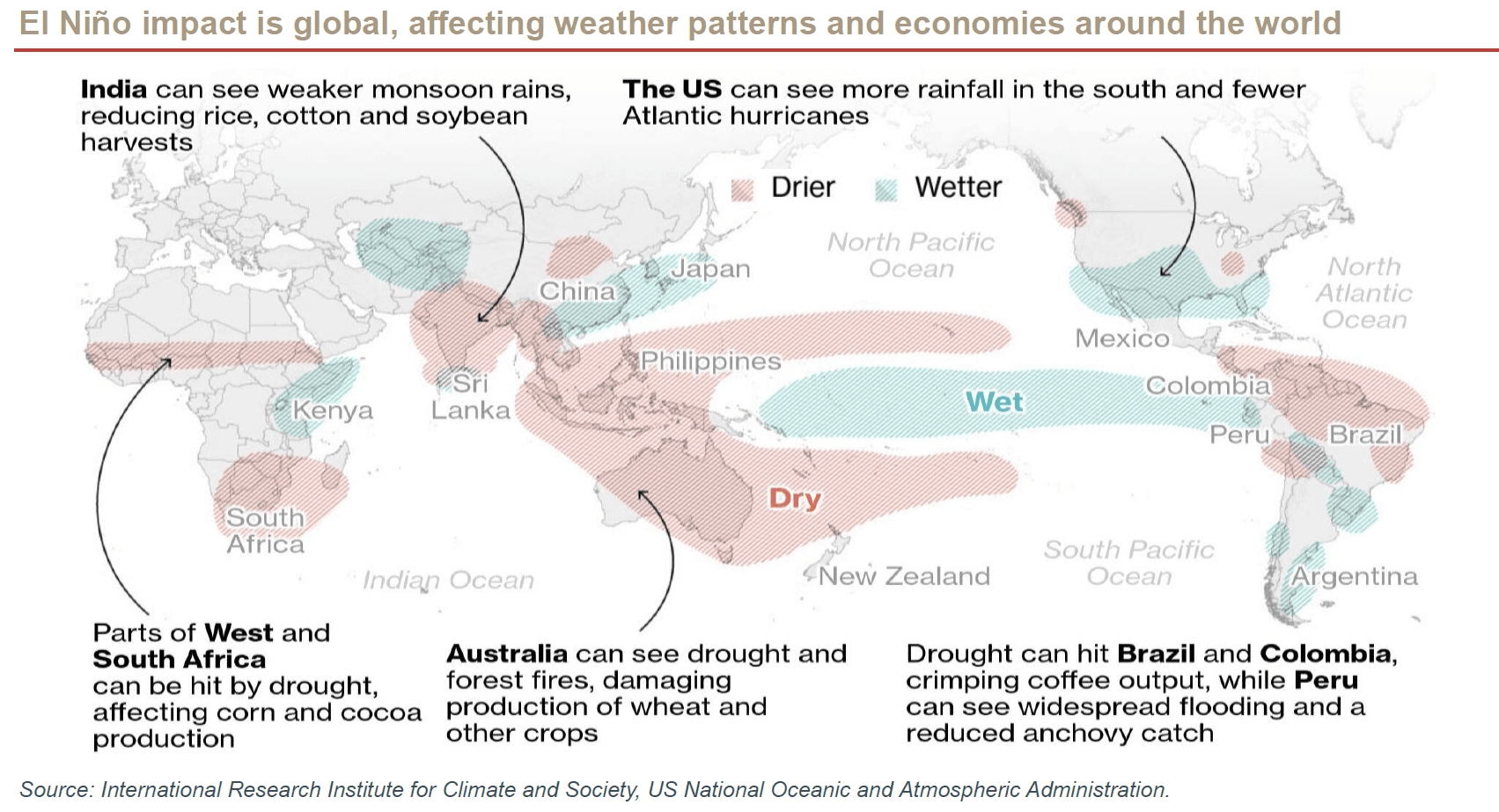
The Wall Street Journal recently published an article titled "The Strongest El Niño in a Generation Is Wreaking Havoc on Global Economy". In a similar vein, Bloomberg wrote "Ex-Balyasny Trader Bets El Niño Can Juice Hedge Fund Returns". We’d like to share a few key takeaways from these pieces regarding the lesser-known investment implications of El Niño (see Appendix A for explanation). Hope you will find them useful.
- Big picture: a generational climate event: Scientists monitoring satellite and ocean data have confirmed that the 2026 El Niño is among the strongest in living memory. Tropical Pacific sea-surface temperatures are now at record highs, compounding the baseline warming from greenhouse gas emissions. Climate researchers warn that El Niño will persist into 2027, potentially making next year the hottest on record and causing trillions of dollars in lost income, especially in tropical economies.
- El Niño-driven chokepoints and supply shocks are already materializing across critical industries:
o Shipping & logistics: The Panama Canal is facing severe drought conditions, with May-Aug rainfall running 34% below historical averages. The canal loses 50 million gallons of water per transit, and has been forced to cut maximum daily vessel transits. Consequently, auction prices for the largest locks have surged to USD 2.5 million (from a typical USD 800,000), as shippers race to secure passage.
o Metals & mining: El Niño usually brings drought, but it can also cause too much rain. In Chile, an unusual storm dumped 5 million cubic meters of snow on the Los Pelambres copper mine, forcing it to stop production. At the same time, dry weather in Papua New Guinea is disrupting river transport. Together, these problems are limiting global copper supply, just as demand from AI data centres is rising and pushing copper prices up.
o Agriculture & aquaculture: Peru’s early suspension of its anchovy catch has sent fish meal prices to record highs. Meanwhile, a 13% deficit in India’s monsoon rains is threatening the global rice supply, echoing the export bans and price spikes seen during the 2023 El Niño.
- How is the smart money playing this? Former Balyasny trader Zulfiqar Ali has explicitly built positions around El Niño-driven dislocations. The trade is about timing and dispersion: droughts and floods hit individual hydrological basins, crop calendars and shipping routes at different paces, creating mispricings across agricultural and energy futures. For hedge funds, these rapid, climate-driven market dislocations can create compelling trading opportunities in commodity markets.
Our Take
While El Niño creates macro friction, it also loads the dice for specific sectors, asset classes, and regional economies. Like the Iran oil crisis this year, a climate-driven commodity shock initially shows up in specific segments of headline CPI (lifting inflation), and later squeezes household real income and industrial input (slowing growth). The overall impact could be slower disinflation into 2027.
Here is our initial thinking:
- Inflation and rates: reinforcing the "higher for longer" regime. El Niño acts as an additional inflationary impulse that compounds existing upward price pressures, reinforcing the risk of sticky headline inflation, and further delaying market expectations for rate cuts. This persistent inflation backdrop reinforces our "higher for longer" view on long-term rates and our cautious stance on long-duration bonds. We maintain 4.5% as a new floor for 10-year Treasury yields, with the upper bound remaining difficult to gauge following recent peaks near 5.34%. We reiterate our preference for short-duration (< 3 years), top-rated (A and above), investment-grade bonds.
- Regional impact: EM and ASEAN vulnerability. The macroeconomic transmission of El Niño is highly heterogeneous. While the US and Europe may see partial offsets (e.g. reduced gas demand from milder winters), Emerging Markets, especially Southeast Asia, are likely to face a severe "double hit" of lower agricultural incomes and higher domestic food prices. Indonesia and Philippines are among the most exposed to risks, from rice inflation to palm oil/robusta coffee production disruptions.
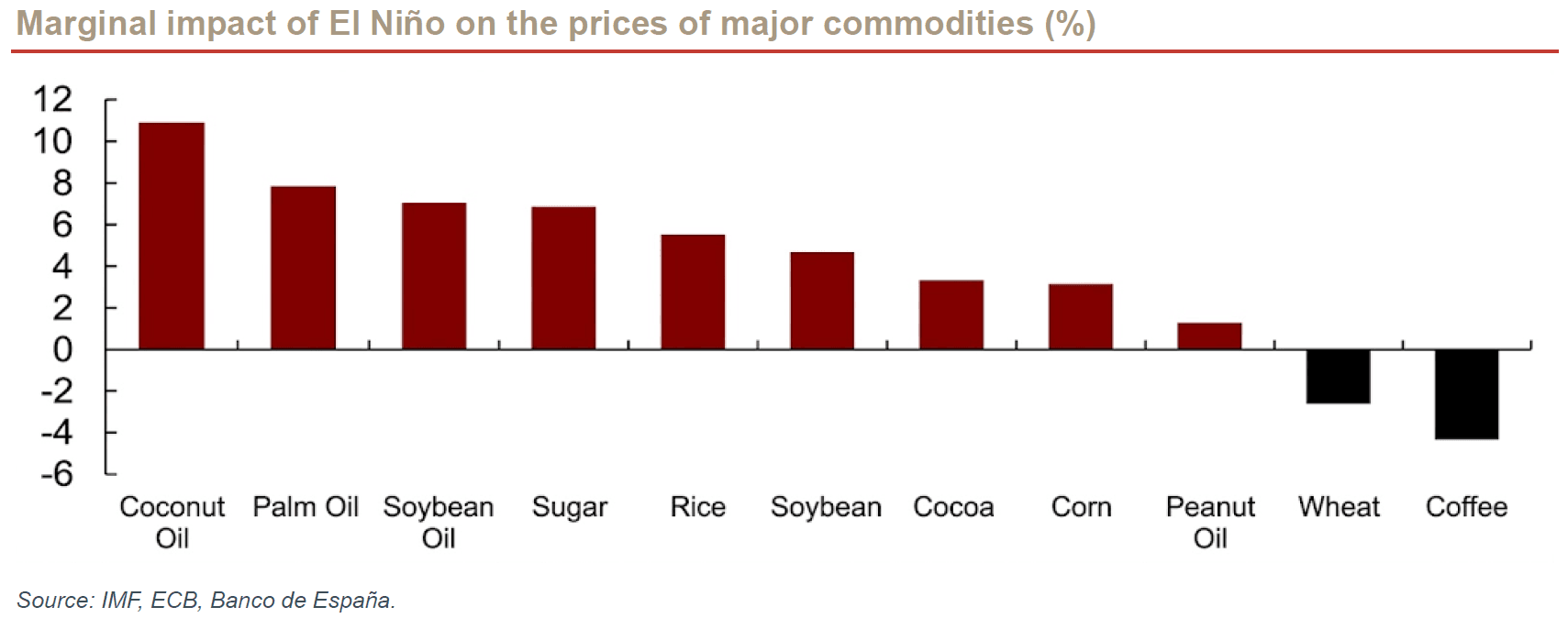
- Commodity impact: concentrated but delayed. Unlike oil shocks that are fast and volatile, food and agricultural disruptions tend to be slower, more persistent, and heavily filtered through global supply chains. Palm oil, coconut oil, and robusta coffee face notable upside price risks due to their geographic concentration in Southeast Asia.
Marginal impact of El Niño on the prices of major commodities (%)
- Initial investment implications: Furthe research is underway to identify high conviction ideas.
Asset Class | Call to Action |
Fixed Income | Stay short duration amid persistent inflation and “higher-for-longer” yields. Climate-driven food and freight inflation is another reason to remain cautious in extending duration. Stick to short-duration (< 3 years), top-rated investment-grade bonds to preserve capital and carry. |
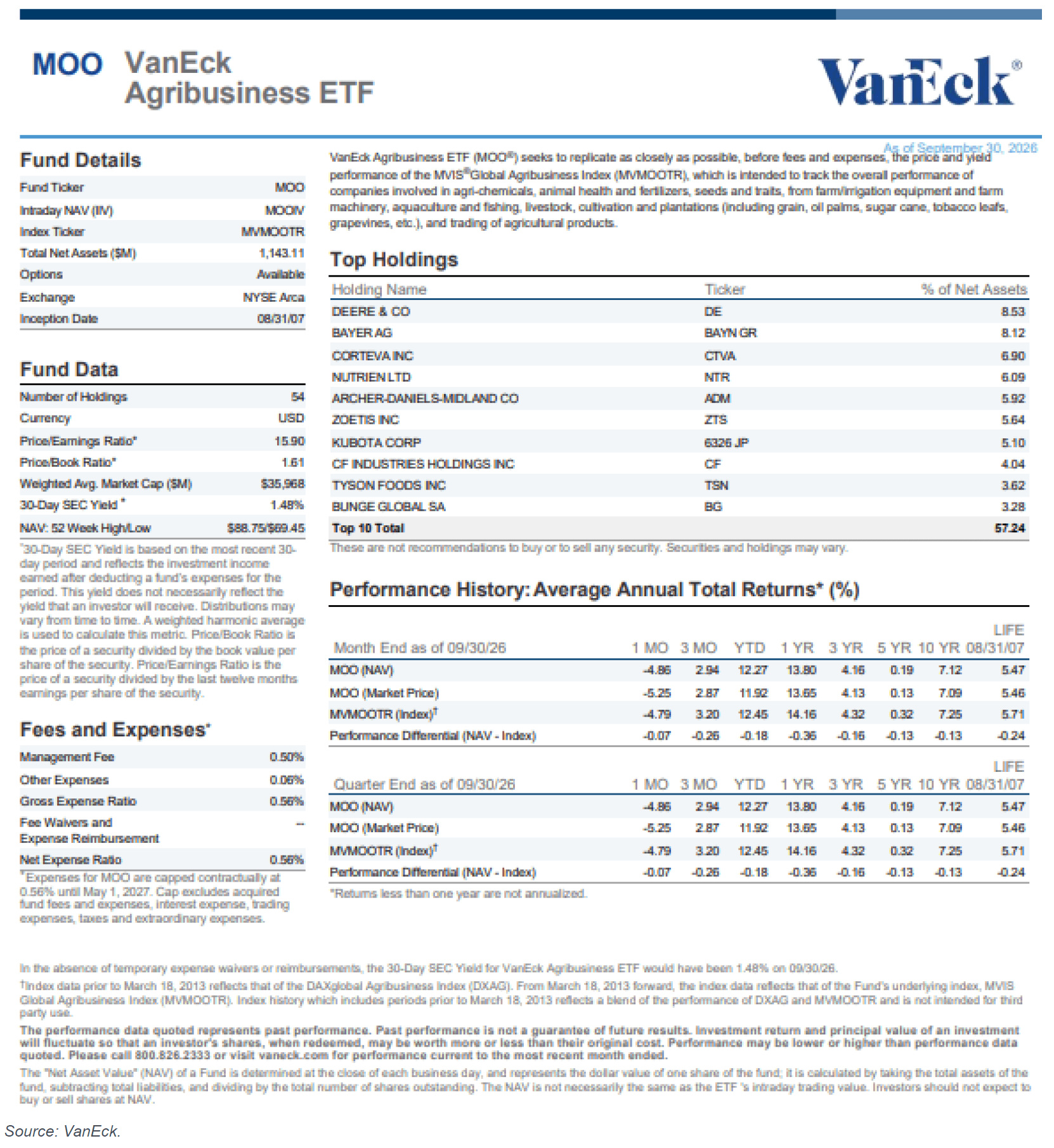
Equities & ETFs | Capture a potential agri-inflation spike. Investors can consider vehicles such as VanEck Agribusiness ETF (MOO) to capture the potential yet persistent upside in grains and agricultural commodities, while avoiding company-specific risk. Idea generation only, not an official recommendation. Refer to Appendix B for more information. |
FX | Stay extra-selective in EM / ASEAN FX, with particular attention to currencies of countries most exposed to food inflation and agricultural disruption. More on that later. |
Appendix A: Basic Primer on El Niño
1. What is El Niño?
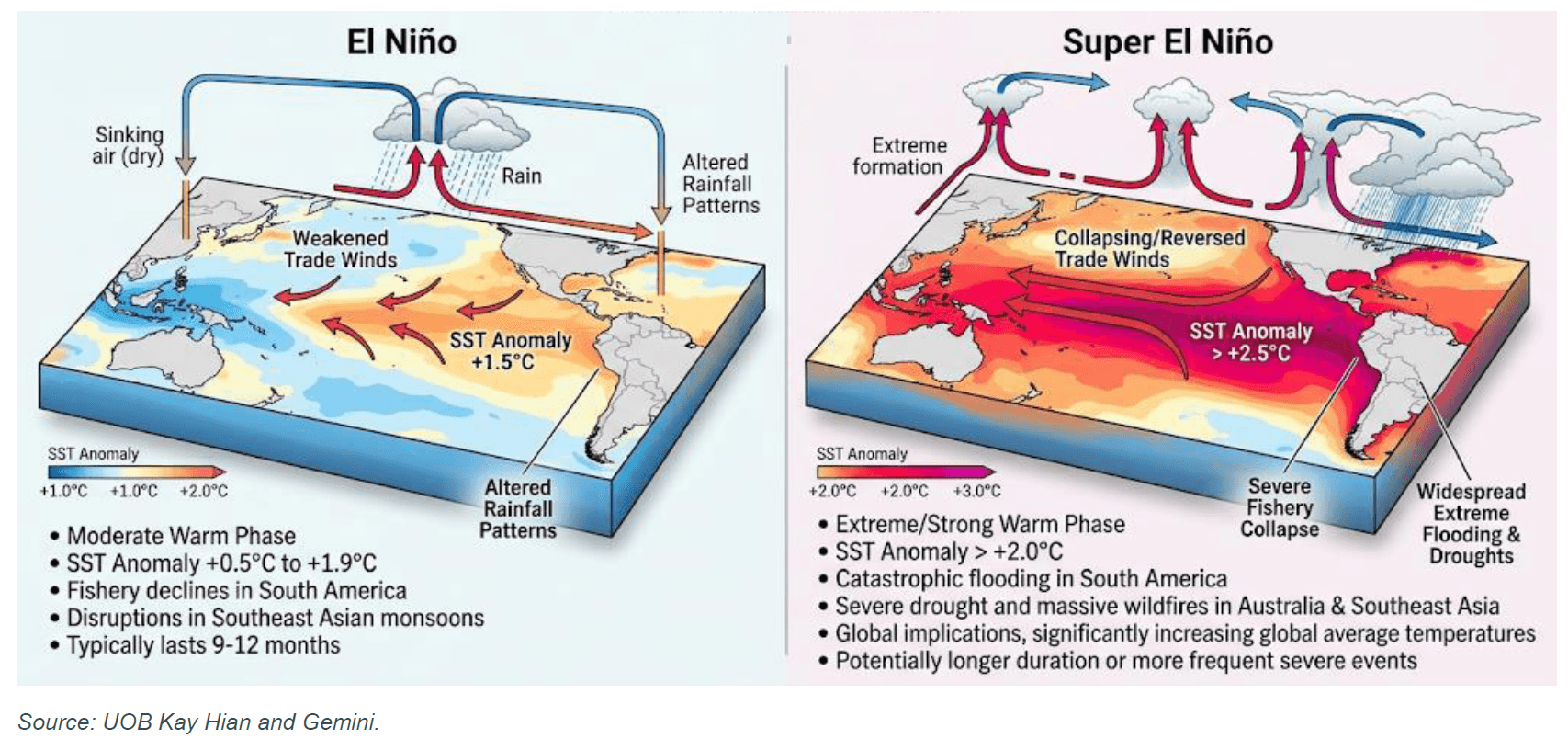
El Niño is a naturally occurring climate pattern characterized by the periodic warming of sea surface temperatures in the central and eastern tropical Pacific Ocean. It represents the warm phase of the El Niño–Southern Oscillation (ENSO) cycle. This shift in ocean temperatures disrupts global atmospheric circulation, altering weather patterns, agricultural output, and commodity markets worldwide.
2. Brief history
- 1600s: Peruvian fishermen first observe warm ocean currents around Christmas, naming the phenomenon El Niño ("The Little Boy").
- 1920s–1960s: Sir Gilbert Walker identifies pressure shifts, which Jacob Bjerknes links to ocean warming in 1969 to form the modern ENSO model.
- 1982–1983: A major event causes global weather extremes, prompting the creation of modern Pacific satellite and ocean buoy monitoring networks.
- 1997–1998: A "Super El Niño" sets global temperature records, causing tens of billions in damage and bringing climate risk to global markets.
- 2015–2016: A powerful event drives record global heat, severe coral bleaching, and major price spikes in crops like cocoa, sugar, and palm oil.
- 2023–2024: Strong warming pushes global average temperatures past historic thresholds, accelerating climate resilience and weather risk insurance adoption.
- Present day: Ocean baselines suggest more frequent extreme ENSO events, elevating climate risk profiling across markets.
3. How El Niño works
- Weakens trade winds: Pacific easterly winds weaken or reverse, letting warm surface water move toward South America.
- Suppresses upwelling: Warm coastal waters block cold, nutrient-rich deep ocean water from rising to feed marine life.
- Shifts convection: Rainfall and storm activity move into the central Pacific, disrupting global jet streams.
- Alters global weather: Triggers severe droughts in Australasia and heavy flooding across the Americas.
4. Key applications & impact areas
- Agricultural commodities: volatility in yields for crops like sugar, cocoa, coffee, and palm oil.
- Energy & utilities: reduces hydroelectric output while driving seasonal power demand spikes.
- Fisheries & aquaculture: sudden crashes in coastal fish populations due to nutrient depletion.
- Supply chain & logistics: Restricts major shipping routes like Panama Canal due to drought.
- Insurance & disaster management: Elevates property damage, crop failure, and infrastructure claims globally.
- Public health: Accelerates vector-borne disease outbreaks like dengue and malaria.
Appendix B: Related ETF Factsheet
The 2026-2027 El Niño is shaping up to be a generational weather event, not only posing major economic risks but also spurring a wave of hedge fund trades. Read on to gauge the climate-driven risks into 2027 and what we can learn from how the smart money is positioning.
CIO Summary
- Generational climate shock fractures global supply chains. Record Pacific temperatures are triggering severe droughts and freak storms, creating acute bottlenecks from the Panama Canal to Southeast Asian agriculture.
- More persistent agri-inflation to slow global disinflation. Unlike fast-moving oil shocks, crop and freight disruptions will likely act as a lingering macro headwind, slowing global disinflation and disproportionately squeezing Emerging Market purchasing power.
- Follow the smart money via ETFs. Institutional "smart money" is actively leveraging climate-induced mispricings to generate alpha in commodities. Their strategies are not easily replicable by individual investors, but agriculture-related ETFs can provide more accessible and transparent exposure to the underlying theme, albeit with higher volatility.
The Wall Street Journal recently published an article titled "The Strongest El Niño in a Generation Is Wreaking Havoc on Global Economy". In a similar vein, Bloomberg wrote "Ex-Balyasny Trader Bets El Niño Can Juice Hedge Fund Returns". We’d like to share a few key takeaways from these pieces regarding the lesser-known investment implications of El Niño (see Appendix A for explanation). Hope you will find them useful.
- Big picture: a generational climate event: Scientists monitoring satellite and ocean data have confirmed that the 2026 El Niño is among the strongest in living memory. Tropical Pacific sea-surface temperatures are now at record highs, compounding the baseline warming from greenhouse gas emissions. Climate researchers warn that El Niño will persist into 2027, potentially making next year the hottest on record and causing trillions of dollars in lost income, especially in tropical economies.
- El Niño-driven chokepoints and supply shocks are already materializing across critical industries:
o Shipping & logistics: The Panama Canal is facing severe drought conditions, with May-Aug rainfall running 34% below historical averages. The canal loses 50 million gallons of water per transit, and has been forced to cut maximum daily vessel transits. Consequently, auction prices for the largest locks have surged to USD 2.5 million (from a typical USD 800,000), as shippers race to secure passage.
o Metals & mining: El Niño usually brings drought, but it can also cause too much rain. In Chile, an unusual storm dumped 5 million cubic meters of snow on the Los Pelambres copper mine, forcing it to stop production. At the same time, dry weather in Papua New Guinea is disrupting river transport. Together, these problems are limiting global copper supply, just as demand from AI data centres is rising and pushing copper prices up.
o Agriculture & aquaculture: Peru’s early suspension of its anchovy catch has sent fish meal prices to record highs. Meanwhile, a 13% deficit in India’s monsoon rains is threatening the global rice supply, echoing the export bans and price spikes seen during the 2023 El Niño.
- How is the smart money playing this? Former Balyasny trader Zulfiqar Ali has explicitly built positions around El Niño-driven dislocations. The trade is about timing and dispersion: droughts and floods hit individual hydrological basins, crop calendars and shipping routes at different paces, creating mispricings across agricultural and energy futures. For hedge funds, these rapid, climate-driven market dislocations can create compelling trading opportunities in commodity markets.
Our Take
While El Niño creates macro friction, it also loads the dice for specific sectors, asset classes, and regional economies. Like the Iran oil crisis this year, a climate-driven commodity shock initially shows up in specific segments of headline CPI (lifting inflation), and later squeezes household real income and industrial input (slowing growth). The overall impact could be slower disinflation into 2027.
Here is our initial thinking:
- Inflation and rates: reinforcing the "higher for longer" regime. El Niño acts as an additional inflationary impulse that compounds existing upward price pressures, reinforcing the risk of sticky headline inflation, and further delaying market expectations for rate cuts. This persistent inflation backdrop reinforces our "higher for longer" view on long-term rates and our cautious stance on long-duration bonds. We maintain 4.5% as a new floor for 10-year Treasury yields, with the upper bound remaining difficult to gauge following recent peaks near 5.34%. We reiterate our preference for short-duration (< 3 years), top-rated (A and above), investment-grade bonds.
- Regional impact: EM and ASEAN vulnerability. The macroeconomic transmission of El Niño is highly heterogeneous. While the US and Europe may see partial offsets (e.g. reduced gas demand from milder winters), Emerging Markets, especially Southeast Asia, are likely to face a severe "double hit" of lower agricultural incomes and higher domestic food prices. Indonesia and Philippines are among the most exposed to risks, from rice inflation to palm oil/robusta coffee production disruptions.
- Commodity impact: concentrated but delayed. Unlike oil shocks that are fast and volatile, food and agricultural disruptions tend to be slower, more persistent, and heavily filtered through global supply chains. Palm oil, coconut oil, and robusta coffee face notable upside price risks due to their geographic concentration in Southeast Asia.
Marginal impact of El Niño on the prices of major commodities (%)
- Initial investment implications: Furthe research is underway to identify high conviction ideas.
Asset Class | Call to Action |
Fixed Income | Stay short duration amid persistent inflation and “higher-for-longer” yields. Climate-driven food and freight inflation is another reason to remain cautious in extending duration. Stick to short-duration (< 3 years), top-rated investment-grade bonds to preserve capital and carry. |
Equities & ETFs | Capture a potential agri-inflation spike. Investors can consider vehicles such as VanEck Agribusiness ETF (MOO) to capture the potential yet persistent upside in grains and agricultural commodities, while avoiding company-specific risk. Idea generation only, not an official recommendation. Refer to Appendix B for more information. |
FX | Stay extra-selective in EM / ASEAN FX, with particular attention to currencies of countries most exposed to food inflation and agricultural disruption. More on that later. |
Appendix A: Basic Primer on El Niño
1. What is El Niño?
El Niño is a naturally occurring climate pattern characterized by the periodic warming of sea surface temperatures in the central and eastern tropical Pacific Ocean. It represents the warm phase of the El Niño–Southern Oscillation (ENSO) cycle. This shift in ocean temperatures disrupts global atmospheric circulation, altering weather patterns, agricultural output, and commodity markets worldwide.
2. Brief history
- 1600s: Peruvian fishermen first observe warm ocean currents around Christmas, naming the phenomenon El Niño ("The Little Boy").
- 1920s–1960s: Sir Gilbert Walker identifies pressure shifts, which Jacob Bjerknes links to ocean warming in 1969 to form the modern ENSO model.
- 1982–1983: A major event causes global weather extremes, prompting the creation of modern Pacific satellite and ocean buoy monitoring networks.
- 1997–1998: A "Super El Niño" sets global temperature records, causing tens of billions in damage and bringing climate risk to global markets.
- 2015–2016: A powerful event drives record global heat, severe coral bleaching, and major price spikes in crops like cocoa, sugar, and palm oil.
- 2023–2024: Strong warming pushes global average temperatures past historic thresholds, accelerating climate resilience and weather risk insurance adoption.
- Present day: Ocean baselines suggest more frequent extreme ENSO events, elevating climate risk profiling across markets.
3. How El Niño works
- Weakens trade winds: Pacific easterly winds weaken or reverse, letting warm surface water move toward South America.
- Suppresses upwelling: Warm coastal waters block cold, nutrient-rich deep ocean water from rising to feed marine life.
- Shifts convection: Rainfall and storm activity move into the central Pacific, disrupting global jet streams.
- Alters global weather: Triggers severe droughts in Australasia and heavy flooding across the Americas.
4. Key applications & impact areas
- Agricultural commodities: volatility in yields for crops like sugar, cocoa, coffee, and palm oil.
- Energy & utilities: reduces hydroelectric output while driving seasonal power demand spikes.
- Fisheries & aquaculture: sudden crashes in coastal fish populations due to nutrient depletion.
- Supply chain & logistics: Restricts major shipping routes like Panama Canal due to drought.
- Insurance & disaster management: Elevates property damage, crop failure, and infrastructure claims globally.
- Public health: Accelerates vector-borne disease outbreaks like dengue and malaria.
Appendix B: Related ETF Factsheet
Disclosures and disclaimers
This report is provided subject to, and must be read together with, the full Disclosures / Disclaimers available at this link, which are incorporated by reference into this report. In particular, this report is intended for general circulation and informational purposes only and does not constitute personal investment advice or a recommendation to buy or sell any investment product or security. You should independently evaluate the information and, where necessary, seek advice from a qualified financial adviser regarding the suitability of any investment. Analyst certifications required under applicable regulations, including SEC Regulation AC (where relevant), are included in this report. By accessing, receiving or using this report, you acknowledge that you have read, understood and agreed to be bound by the Disclosures / Disclaimers, as may be amended, supplemented or updated from time to time.


