

Wealth Flash
The Knowledge Share
AI Cooldown after the Blue Sweep: Shaken, Not Broken
Following US midterm Blue Sweep, all five of our top predictions for 2026 have now come true, including the Great AI Capex Cooldown. But the implications are more nuanced than the market reaction suggests. Read on to find out why we remain bullish on AI’s long-term growth.
CIO Summary
- Blue Sweep raises the risk of an AI capex cooldown. The unexpectedly decisive Democratic victory in the US midterm elections increases state-level policy risk for AI data-center buildout. Tighter rules around permitting, power, water and local approvals could slow the pace of AI infrastructure spending, supporting our thesis on the Great AI Capex Cooldown.
- Near-term impact is likely more limited than the market fears. Hyperscalers have not announced any capex cuts so far, and much of the 2027 data-center pipeline is already committed. With projects typically taking 24–36 months to build, meaningful post-election policy tightening is more likely to affect 2028 and beyond, giving hyperscalers time to adapt and adjust.
- Bottom line: shaken, not broken. State-level policy risk is real, but it is more nuanced and medium-term than direct and immediate. Structural AI demand, the US-China AI race and local economic incentives remain powerful counterweights. We therefore see the sell-off as more sentiment- and positioning-driven than fundamentals-driven.
Before the midterm elections, we highlighted our base case of a “Blue Sweep”, i.e. Democrat winning the majority for both the Senate and the House. On November 3rd, the Blue Wave came in as we expected, yet the magnitude of the Democratic win was a major surprise to both us and the market. Not only did Democrats win decisive majority in the Senate (current counts suggests 54 seats), but Republican also lost traditional stronghold of Texas after claiming it for 38 years.
The midterm shock quickly shifted from the ballot box onto the trading tape over the next 48 hours. US market experienced a violent sell-off. On day one after the election, the broader market (S&P 500) still rallied 1.6% on expectations of a pivot toward the political center. Day two brought a sharp catch-down, with the VIX posting its largest one-day surge of 70% since 2018. The liquidation then became self-reinforcing, as leveraged ETF rebalancing amplified the decline in US equities, triggering mechanical selling pressure into the close.
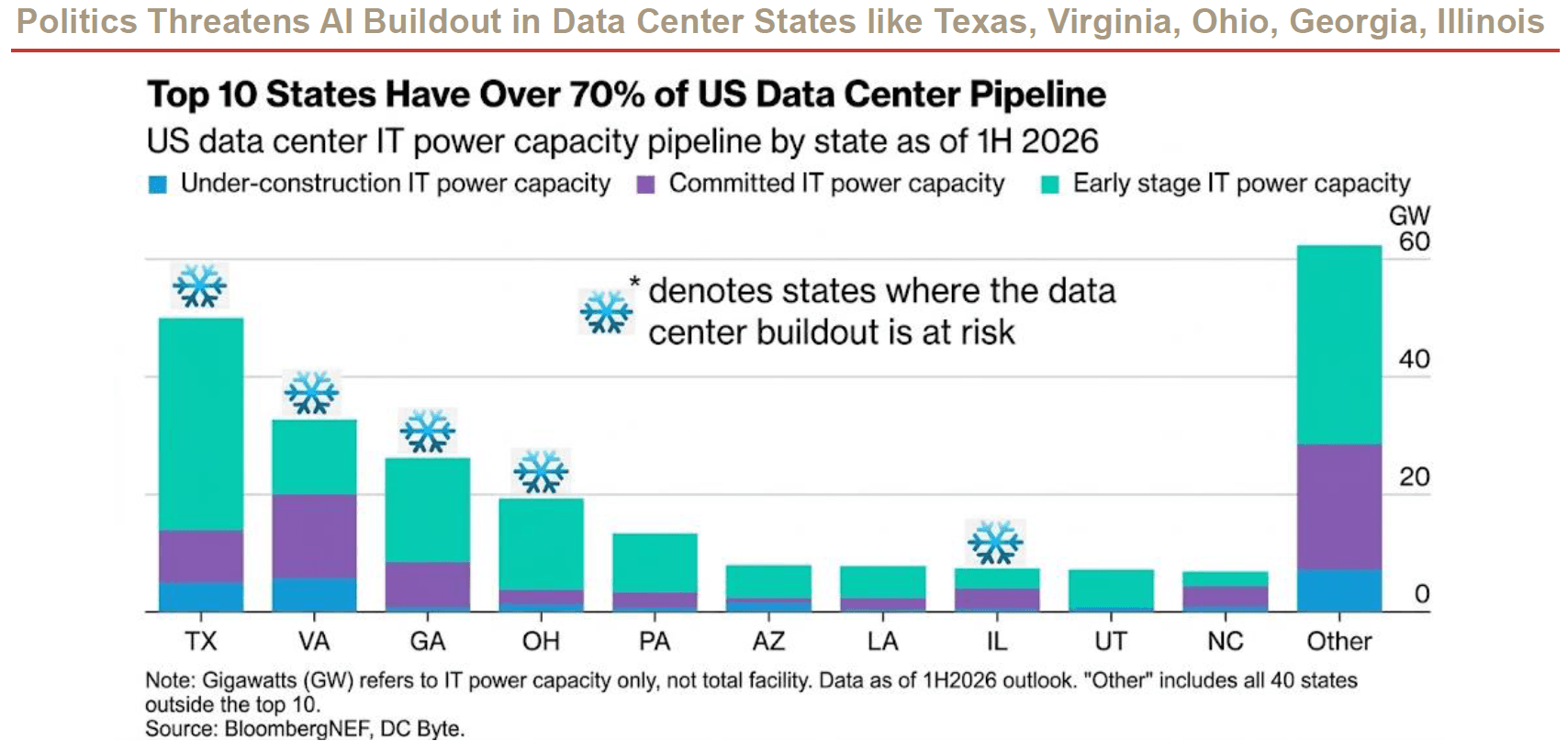
What is the market worried about? The central concern is that a Democratic "Blue Sweep" could slow the AI buildout. With 46 of 47 local referendums backing AI data-center restrictions and Democrats capturing governorships in key data-center states, getting new capacity approvals could become harder. If land, power and rack capacity cannot keep pace with demand, fewer chips can be deployed, potentially leaving chip supply in relative surplus and eroding the scarcity premium on bottleneck hardware. This is part of the original logic behind the Great AI Capex Cooldown, one of our top predictions for 2026.
Our Take
The Blue Sweep may support our “Great AI Capex Cooldown” thesis, but the impact is likely to be more nuanced. Despite the heightened political risk, we see little evidence or reason for an imminent collapse in AI investment. Our central prediction remains that AI capex growth would cool, not collapse, while AI’s long-term growth potential is intact.
- Fact check: AI capex has not rolled over. Despite growing scrutiny around power costs, grid capacity, water, permitting and tax incentives throughout 2026, there has been no broad-based pullback in hyperscaler capex so far. Our latest Wealth Monthly noted that these policy pressures are not new and have done little to derail the AI investment boom to date. Overall, US hyperscaler capex is still expected to grow some 85% in 2026E and 65% in 2027E.
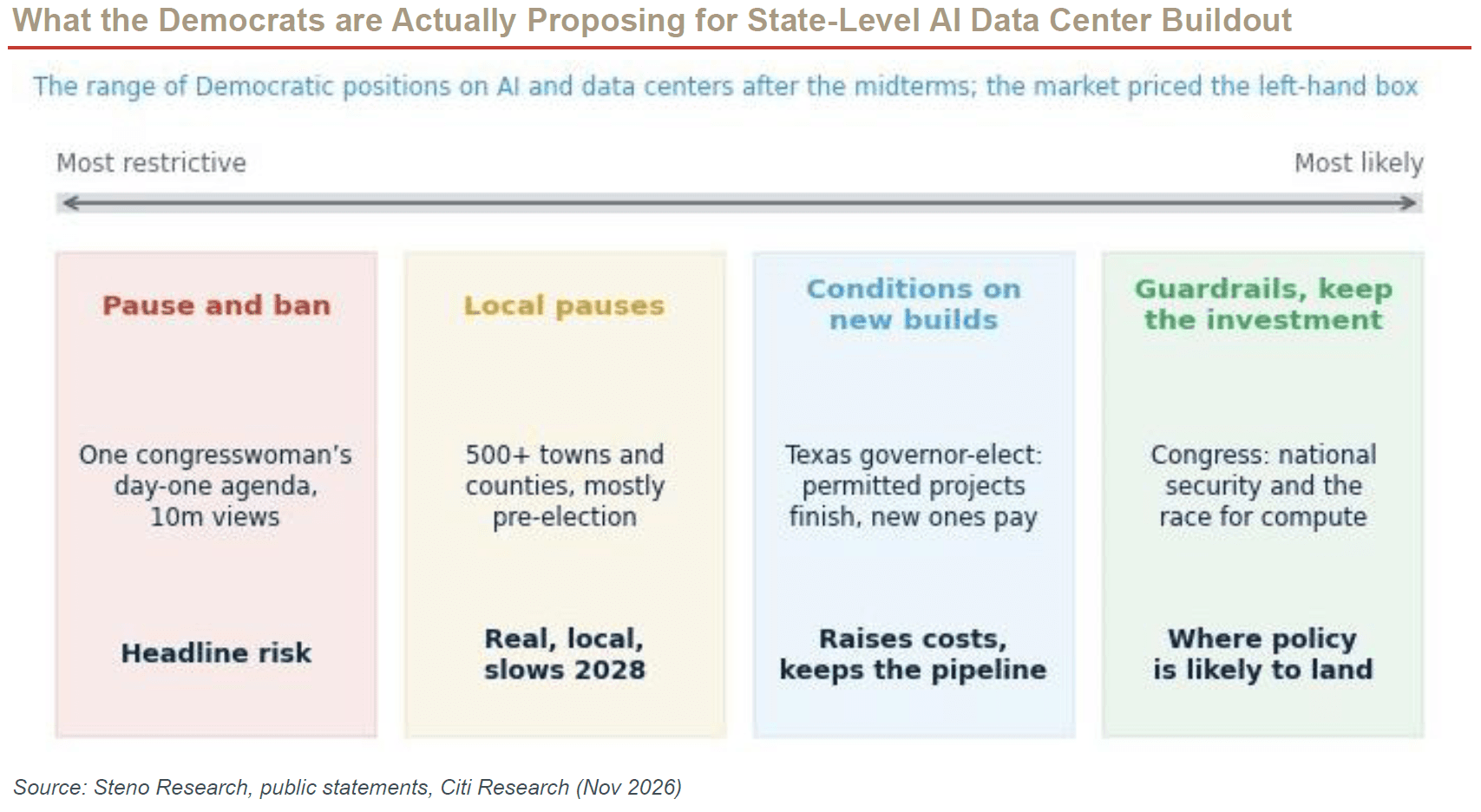
- Policy risk is real, but more nuanced than the market’s initial “pause-and-ban” reaction suggests. Our state-by-state work shows a wide spectrum of possible policies (see chart above), ranging from outright pauses to additional conditions on new projects and relatively modest guardrails. However, most critical states are not embracing the most extreme restrictions (see table below), contrary to the market’s initial fear of a universal clampdown.
State | Midterm Election Implications to Data Centre Buildout | Pause-and-ban? |
Texas | Democratic governor-elect campaigned on a temporary moratorium. Texas already has agency-level pauses around grid/environmental approvals. | No |
Virginia | Not a blue flip case, but already facing explicit restrictions on large data centers | No |
Ohio | Democratic governor-elect campaigned on a conditional data-center moratorium; existing incentives have already been tightened. | No |
Georgia | Democratic governor-elect is planning to pause new projects. | Likely |
Illinois | Already Democratic-led and already paused data-center tax incentives and pushed ratepayer/water restrictions. | No |
- 2027 is largely locked in; the bigger question is 2028 and beyond. Almost all newly elected officials will take office by January 2027, making major new post-election restrictions unlikely before 1Q2027. More importantly, data centers typically require 24–36 months to build, meaning much of the 2027 expansion pipeline has already been committed. This was recently confirmed by state officials such as Texas Governor-elect Gina Hinojosa. Any meaningful tightening is therefore more likely to affect projects in 2028 and beyond, giving hyperscalers time to relocate, redesign or adapt planned capacity.
- Bottom line: shaken, not broken. State-level policy risk has increased and reinforces our view that the breakneck pace of AI infrastructure growth cannot continue indefinitely. But the risk remains more medium-term than immediate, while structural AI demand, the US-China AI race and states’ own economic incentives remain powerful counterweights. Beyond the states, even at the congressional level, the Democratic stance on AI is far from uniformly negative (see Appendix). For now, we view the sell-off as more sentiment- and positioning-driven than fundamentals-driven.
Appendix: View spectrum of key Democrats
With Democrats having won a sweeping victory and taken control of Congress, the internal balance between the party’s moderates (centrist) and progressive (left wing) will help shape the legislative landscape. In short, the Democratic Party is not uniformly anti-tech. Below, we summarize key Democratic figures’ public positions on AI to provide a more nuanced view of where the Blue Wave stands.
Key politicians | Perceived category | Public views related to AI |
Chuck Schumer | Centrist (Senate leader) | Championed the 2024 bipartisan AI roadmap, pushing for $32bn in federal R&D funding to "consolidate US AI leadership" against global competitors. Balances national security guardrails with the core goal of ensuring America remains the global epicentre of tech development. |
Kamala Harris | Centrist | Focuses on frontier risks (cyberattacks, autonomous weapons), stressed developer accountability at the negotiating table. |
Mark Warner | Centrist | Advocated that the US must out-innovate rivals like China in AI and semiconductors. |
Alexandria Ocasio-Cortez | Left Wing | Focuses heavily on labour protections. Champions data center moratoriums prioritizing environmental, electricity, and community consent thresholds. |
Bernie Sanders | Left Wing (Independent) | Warns of severe automation job displacement. Co-sponsored the Ban Artificial Superintelligence Act (Sep 2026) and data center pause legislation. |
Following US midterm Blue Sweep, all five of our top predictions for 2026 have now come true, including the Great AI Capex Cooldown. But the implications are more nuanced than the market reaction suggests. Read on to find out why we remain bullish on AI’s long-term growth.
CIO Summary
- Blue Sweep raises the risk of an AI capex cooldown. The unexpectedly decisive Democratic victory in the US midterm elections increases state-level policy risk for AI data-center buildout. Tighter rules around permitting, power, water and local approvals could slow the pace of AI infrastructure spending, supporting our thesis on the Great AI Capex Cooldown.
- Near-term impact is likely more limited than the market fears. Hyperscalers have not announced any capex cuts so far, and much of the 2027 data-center pipeline is already committed. With projects typically taking 24–36 months to build, meaningful post-election policy tightening is more likely to affect 2028 and beyond, giving hyperscalers time to adapt and adjust.
- Bottom line: shaken, not broken. State-level policy risk is real, but it is more nuanced and medium-term than direct and immediate. Structural AI demand, the US-China AI race and local economic incentives remain powerful counterweights. We therefore see the sell-off as more sentiment- and positioning-driven than fundamentals-driven.
Before the midterm elections, we highlighted our base case of a “Blue Sweep”, i.e. Democrat winning the majority for both the Senate and the House. On November 3rd, the Blue Wave came in as we expected, yet the magnitude of the Democratic win was a major surprise to both us and the market. Not only did Democrats win decisive majority in the Senate (current counts suggests 54 seats), but Republican also lost traditional stronghold of Texas after claiming it for 38 years.
The midterm shock quickly shifted from the ballot box onto the trading tape over the next 48 hours. US market experienced a violent sell-off. On day one after the election, the broader market (S&P 500) still rallied 1.6% on expectations of a pivot toward the political center. Day two brought a sharp catch-down, with the VIX posting its largest one-day surge of 70% since 2018. The liquidation then became self-reinforcing, as leveraged ETF rebalancing amplified the decline in US equities, triggering mechanical selling pressure into the close.
What is the market worried about? The central concern is that a Democratic "Blue Sweep" could slow the AI buildout. With 46 of 47 local referendums backing AI data-center restrictions and Democrats capturing governorships in key data-center states, getting new capacity approvals could become harder. If land, power and rack capacity cannot keep pace with demand, fewer chips can be deployed, potentially leaving chip supply in relative surplus and eroding the scarcity premium on bottleneck hardware. This is part of the original logic behind the Great AI Capex Cooldown, one of our top predictions for 2026.
Our Take
The Blue Sweep may support our “Great AI Capex Cooldown” thesis, but the impact is likely to be more nuanced. Despite the heightened political risk, we see little evidence or reason for an imminent collapse in AI investment. Our central prediction remains that AI capex growth would cool, not collapse, while AI’s long-term growth potential is intact.
- Fact check: AI capex has not rolled over. Despite growing scrutiny around power costs, grid capacity, water, permitting and tax incentives throughout 2026, there has been no broad-based pullback in hyperscaler capex so far. Our latest Wealth Monthly noted that these policy pressures are not new and have done little to derail the AI investment boom to date. Overall, US hyperscaler capex is still expected to grow some 85% in 2026E and 65% in 2027E.
- Policy risk is real, but more nuanced than the market’s initial “pause-and-ban” reaction suggests. Our state-by-state work shows a wide spectrum of possible policies (see chart above), ranging from outright pauses to additional conditions on new projects and relatively modest guardrails. However, most critical states are not embracing the most extreme restrictions (see table below), contrary to the market’s initial fear of a universal clampdown.
State | Midterm Election Implications to Data Centre Buildout | Pause-and-ban? |
Texas | Democratic governor-elect campaigned on a temporary moratorium. Texas already has agency-level pauses around grid/environmental approvals. | No |
Virginia | Not a blue flip case, but already facing explicit restrictions on large data centers | No |
Ohio | Democratic governor-elect campaigned on a conditional data-center moratorium; existing incentives have already been tightened. | No |
Georgia | Democratic governor-elect is planning to pause new projects. | Likely |
Illinois | Already Democratic-led and already paused data-center tax incentives and pushed ratepayer/water restrictions. | No |
- 2027 is largely locked in; the bigger question is 2028 and beyond. Almost all newly elected officials will take office by January 2027, making major new post-election restrictions unlikely before 1Q2027. More importantly, data centers typically require 24–36 months to build, meaning much of the 2027 expansion pipeline has already been committed. This was recently confirmed by state officials such as Texas Governor-elect Gina Hinojosa. Any meaningful tightening is therefore more likely to affect projects in 2028 and beyond, giving hyperscalers time to relocate, redesign or adapt planned capacity.
- Bottom line: shaken, not broken. State-level policy risk has increased and reinforces our view that the breakneck pace of AI infrastructure growth cannot continue indefinitely. But the risk remains more medium-term than immediate, while structural AI demand, the US-China AI race and states’ own economic incentives remain powerful counterweights. Beyond the states, even at the congressional level, the Democratic stance on AI is far from uniformly negative (see Appendix). For now, we view the sell-off as more sentiment- and positioning-driven than fundamentals-driven.
Appendix: View spectrum of key Democrats
With Democrats having won a sweeping victory and taken control of Congress, the internal balance between the party’s moderates (centrist) and progressive (left wing) will help shape the legislative landscape. In short, the Democratic Party is not uniformly anti-tech. Below, we summarize key Democratic figures’ public positions on AI to provide a more nuanced view of where the Blue Wave stands.
Key politicians | Perceived category | Public views related to AI |
Chuck Schumer | Centrist (Senate leader) | Championed the 2024 bipartisan AI roadmap, pushing for $32bn in federal R&D funding to "consolidate US AI leadership" against global competitors. Balances national security guardrails with the core goal of ensuring America remains the global epicentre of tech development. |
Kamala Harris | Centrist | Focuses on frontier risks (cyberattacks, autonomous weapons), stressed developer accountability at the negotiating table. |
Mark Warner | Centrist | Advocated that the US must out-innovate rivals like China in AI and semiconductors. |
Alexandria Ocasio-Cortez | Left Wing | Focuses heavily on labour protections. Champions data center moratoriums prioritizing environmental, electricity, and community consent thresholds. |
Bernie Sanders | Left Wing (Independent) | Warns of severe automation job displacement. Co-sponsored the Ban Artificial Superintelligence Act (Sep 2026) and data center pause legislation. |
Disclosures and disclaimers
This report is provided subject to, and must be read together with, the full Disclosures / Disclaimers available at this link, which are incorporated by reference into this report. In particular, this report is intended for general circulation and informational purposes only and does not constitute personal investment advice or a recommendation to buy or sell any investment product or security. You should independently evaluate the information and, where necessary, seek advice from a qualified financial adviser regarding the suitability of any investment. Analyst certifications required under applicable regulations, including SEC Regulation AC (where relevant), are included in this report. By accessing, receiving or using this report, you acknowledge that you have read, understood and agreed to be bound by the Disclosures / Disclaimers, as may be amended, supplemented or updated from time to time.


