

Wealth Daily
AI Funding Expands As Brazil Sells Off
Today’s Must-Know News
Overnight Markets
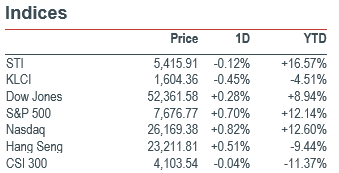
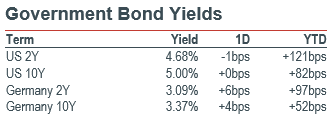
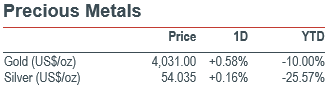
Market Movers: At the 26 October close, the S&P 500 gained 0.70%. Meta (META US) fell 1.88% after launching approximately US$35bn of equity and convertible-preferred offerings and planning a future US$60bn at-the-market programme, raising dilution risk. Microsoft (MSFT US) rose 1.54% as it offered voluntary exits to about 60,000 employees. Tesla (TSLA US) rallied 5.21% after Barclays upgraded it to Overweight. After the U.S. close, Blackstone disclosed a US$63bn financing vehicle for Broadcom (AVGO US) equipment to be leased to Anthropic. This supports AI capacity but creates contingent exposure for Broadcom through residual-value support. Anthropic’s IPO filing showed first-half revenue of US$16.29bn versus US$1.16bn a year earlier. Brazil’s Ibovespa fell 13.9% after Lula’s re-election upset expectations of a more market-friendly government, underscoring country-specific policy risk. (Meta / Reuters / StreetInsider / Blackstone / Reuters / Reuters) Meta (META US), Microsoft (MSFT US) and Broadcom (AVGO US) are our Core Recommendations.
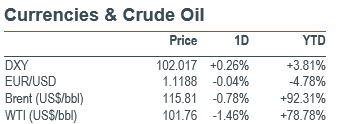
FICC: December Brent settled 0.78% lower at US$115.81/bbl and WTI fell 1.46% to US$101.76/bbl as renewed Saudi-Iran talks encouraged hopes of easing hostilities. Attacks on energy infrastructure and shipping kept supply risks elevated. Brazil’s real weakened 8.1% to BRL5.415 per U.S. dollar, while five-year sovereign credit-default-swap spreads rose to 144bps from 120bps. The Treasury cancelled two scheduled bond auctions. Currency losse and higher sovereign risk premiums could tighten financing conditions and pressure importers. (Herald Business / Reuters)
AI
• Equity funding shifts Meta’s AI costs towards shareholders. Meta Platforms (META US) launched approximately US$35bn of common and convertible-preferred offerings and outlined a further US$60bn share-sale programme that remains uncommitted. Three chipmakers expressed nonbinding interest in up to US$5bn of stock. With FY26 capex forecast at US$135bn–145bn, equity broadens funding capacity while increasing dilution risk. (Meta / Reuters) Meta Platforms (META US) is our Core Recommendation.
• Banks finance another large block of AI compute. Broadcom (AVGO US) and financial partners announced a US$63bn financing vehicle after the U.S. close to buy its accelerators and networking equipment for lease to Anthropic. Deliveries are expected from 2027. Broadcom’s residual-value support equals the senior financing amount, linking chip demand to a contingent balance-sheet exposure if equipment values disappoint. (Blackstone) Broadcom (AVGO US) is our Core Recommendation.
• Anthropic’s public filing makes AI funding economics explicit. Anthropic filed for a Nasdaq IPO without setting an offer size or price range. Its 1H26 revenue reached US$16.29bn, versus US$1.16bn a year earlier, while operating losses narrowed to US$693mn from US$2.14bn. More than US$600bn of decade-long partner commitments leave strong demand growth alongside substantial future funding obligations. (Anthropic / Reuters)
• Lower-cost computer use sharpens competition in enterprise agents. OpenAI launched GPT-6.1 Terra at US$1 per million input tokens and US$5 per million output tokens, halving standard API prices versus GPT-5.6 Terra and GPT-6.1 Sol. Its workplace-software benchmark improved by 15 percentage points against GPT-5.6 Terra at medium reasoning effort, the company says. Lower task costs could broaden enterprise automation demand. (OpenAI)
Americas
• Microsoft expands voluntary exits as AI spending accelerates. Microsoft (MSFT US) offered buyouts to roughly 60,000 employees, over a quarter of its 223,000 workforce, across four countries. Reuters puts planned calendar-year capex at US$175bn. Shares rose 1.54% at the U.S. close. Eligible headcount is not an announced reduction; take-up and severance costs will determine the financial benefit. (Microsoft / Reuters / Market data) Microsoft (MSFT US) is our Core Recommendation.
• Barclays’ upgrade adds transaction optionality to Tesla’s outlook. Tesla (TSLA US) gained 5.21% at the U.S. close after Barclays raised its rating to Overweight and target to US$450 from US$370. The bank cited improving fundamentals and a possible SpaceX combination. Independent committees are exploring the transaction, but unsettled terms leave deal value uncertain alongside automotive and autonomy execution risks. (Proactive / StreetInsider / Market data)
• Optical demand attracts a new bullish brokerage call. Lumentum (LITE US) climbed 8.19% at the U.S. close after StoneX initiated coverage at Buy with a US$1,200 target. StoneX also began Coherent at Buy, citing AI demand for optical components. The target remains a broker valuation; customer orders and capacity conversion will determine how much infrastructure spending reaches earnings. (Investing.com / Market data) Lumentum (LITE US) is our Investment Opportunity.
• Brazil’s election shock forces a repricing of risk. Brazil’s Ibovespa closed approximately 13.9% lower after Lula’s surprise re-election, its largest decline since March 2020. B3 triggered a 30-minute halt when the index fell 10%. Five-year sovereign CDS widened to 144bps from 120bps, and the Treasury cancelled two bond auctions. Fiscal adjustment and the finance-minister appointment now dominate policy expectations. (Reuters)
• Celestica’s results strengthen the AI infrastructure demand signal. Celestica (CLS US) reported after the U.S. close that 3Q revenue rose 83% YoY to US$5.83bn and adjusted operating margin expanded to 8.5% from 7.6%. Initial FY27 revenue guidance of US$40bn implies 90% growth. Yet FY26 free-cash-flow guidance fell to US$460mn from US$600mn as working-capital needs increased, highlighting the cash demands of expansion. (Celestica)
• Subscriber momentum improves, but equipment weakness restrains Verizon. Verizon Communications (VZ US) added 406,000 postpaid phone subscribers and raised its FY26 target to 1.1mn–1.2mn, yet shares fell 3.49% at the U.S. close. Revenue grew 1.5% YoY to US$34.3bn, below consensus, as fewer upgrades reduced equipment sales. An AWS fibre agreement exceeding US$2bn adds a separate infrastructure growth opportunity. (Verizon / Reuters / Market data)
• Instacart talks raise the stakes in delivery consolidation. Instacart (CART US) gained 7.87% and DoorDash (DASH US) fell 6.10% at the cash close following reports of advanced takeover talks. Reuters’ subsequent update put the potential deal at roughly US$17bn; agreement remains uncertain. Combining grocery and restaurant delivery could broaden customer reach, while purchase economics, integration and regulatory scrutiny remain risks. (Reuters / Market data / Market data)
• Cadence raises growth guidance as design demand strengthens. Cadence Design Systems (CDNS US) reported after the U.S. close that 3Q revenue rose 22% YoY to US$1.633bn, with recurring revenue up 18% and backlog at US$8.2bn. FY26 revenue growth guidance rose to approximately 21%, supporting demand visibility, although the non-GAAP operating margin narrowed to 44.1% from 47.6% a year earlier. (Cadence)
• EQT’s Range acquisition creates a larger gas supply platform. EQT (EQT US) agreed to acquire Range Resources (RRC US) for 0.987 EQT shares per Range share, creating enterprise value above US$50bn. Range rose 17.66% at the U.S. close. Management targets US$325mn of annual synergies within two years; regulatory approvals, integration and commodity-price sensitivity remain the key execution risks. (EQT / Market data)
Greater China
• Meituan seeks fresh offshore yuan funding. Meituan (3690.HK) proposed offshore yuan notes, primarily to refinance offshore debt. Bloomberg reported a target equivalent to about US$1bn, with final terms unsettled. Shares rose approximately 3.3% at the Hong Kong close. Refinancing could extend funding flexibility, although pricing determines the interest burden. (Company / Bloomberg / Market data) Meituan (3690.HK) is our Investment Opportunity.
• WuXi AppTec raises its full-year revenue outlook. WuXi AppTec (2359.HK) lifted FY26 revenue guidance to RMB61.0–61.9bn from RMB58.5–60.5bn in its after-close release. Nine-month revenue rose 38.6% YoY to RMB45.5bn, while adjusted non-IFRS net profit increased 74.4% to RMB18.4bn. Continuing-operations backlog grew 36.4% to RMB76.7bn, strengthening revenue visibility as customer projects scale across its integrated research and manufacturing platform. (Company)
• China adds a liquidity backstop for bond funds. The PBOC established a swap facility allowing eligible bank wealth managers and public fund managers to borrow central-bank bills for repo financing during systemic bond-market stress. Funds can support bond purchases or redemption liquidity. Bank wealth products alone held RMB33.3trn at end-2025, underscoring the potential reach of this conditional backstop. (PBOC / Xinhua)
Asia ex. China
• SK hynix clarifies its shareholder-return plans. SK hynix (000660.KS) disclosed completion of a KRW40.0trn repurchase covering 23.7mn shares, with cancellation planned. Separately, it said a reported KRW16trn special dividend remained undecided and shareholder-return measures were under review. The new filings distinguish completed capital returns from an unapproved payout, limiting the certainty investors can attach to additional distributions. (SEC / SEC)
• GMO sells off as cyberattack compensation costs emerge. GMO Internet Group (9449.T) fell approximately 15.7% in the first Tokyo session after Sunday's compensation announcement. It pledged repayment of unauthorised foreign-exchange trading losses and ¥5,000 goodwill payments to customers, while saying the earnings impact could not yet be calculated. Japan's government also announced plans for emergency cybersecurity measures, highlighting broader operational risks. (Reuters / Market data)
• Keppel advances completion of four legacy offshore rigs. Keppel (BN4.SI) and Seatrium (5E2.SI) agreed construction work exceeding S$500mn for four rigs owned by Keppel's RigCo subsidiary, financed from RigCo's existing cash. The package comprises a drillship, a harsh-environment jackup and two semisubmersibles. Completing these assets supports Keppel's monetisation programme, while adding work for Seatrium under the companies' existing services arrangement. (SGX)
EMEA and Others
• Genmab rallies on colorectal-cancer trial results. Genmab (GMAB.CO) rose approximately 12.1% in the first session after Sunday's petosemtamab update. Phase 2 data showed confirmed and unconfirmed response rates of 75% in first-line and 67% in second-line colorectal-cancer patients receiving combination therapy. These early results strengthen the development case, although larger Phase 3 studies remain necessary to establish clinical benefit. (Company / Reuters / Market data)
• Computacenter lifts profit guidance as infrastructure demand strengthens. Computacenter (CCC.L) rose approximately 13.1% after forecasting FY26 adjusted pretax profit of at least £425mn, above company-compiled consensus of £387.1mn. Its committed product backlog reached £12.6bn, versus £9.3bn at June-end. Hyperscale and neocloud customers drove strong sourcing growth, reinforcing demand visibility, although managed-services revenue declined and backlog still needs to convert into earnings. (Company / Reuters / Market data)
• Galp drops as downstream merger talks collapse. Galp (GALP.LS) fell approximately 10.8% after abandoning talks to combine downstream operations with Moeve, citing unsatisfactory commercial terms. The proposed industrial venture would have processed about 700,000 barrels daily. Strong refining margins nevertheless lifted 3Q adjusted EBITDA 67% YoY to €1.5bn. The failed transaction leaves ownership unchanged and removes a potential restructuring catalyst. (Reuters / Reuters / Market data)
• Telefónica falls following a broker downgrade. Telefónica (TEF.MC) declined approximately 6.4% after JPMorgan cut its rating to Underweight from Neutral and its price target to €3.2 from €3.7. The broker highlighted roughly £22bn of debt at Virgin Media O2 and projected leverage of 5.9 times at year-end. These are analyst assessments, but they sharpen attention on refinancing and cash-flow resilience. (Investing.com / Market data)
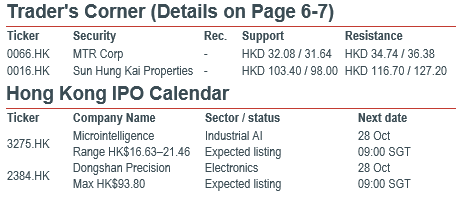
Traders' Corner
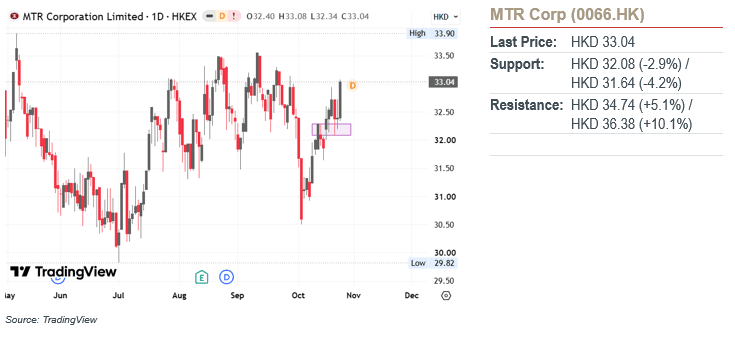
Our Technical View
Price rebounded from its resistance-turned-support zone, maintaining a sequence of higher highs and higher lows.
The RSI remains in bullish territory and is turning upward with positive velocity.
As long as price respects this converted demand, we see continued upward expansion toward overhead resistance.
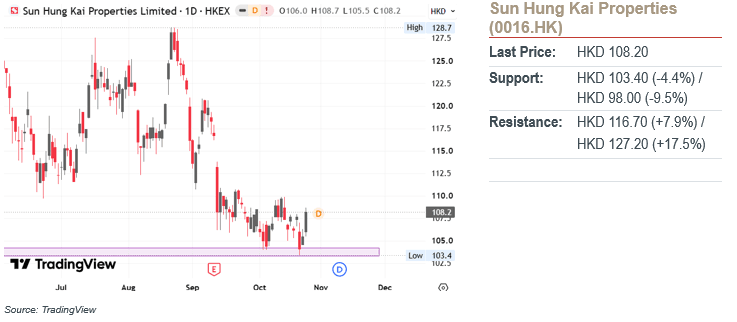
Our Technical View
Price rebounded after retesting its prior low support baseline, establishing the potential Double Bottom chart pattern.
Technical momentum corroborates this base-building process: a potential bullish divergence warning has emerged on the RSI.
As long as price maintains above this defended support zone, we see base formation and an upward movement toward the pattern’s intermediate neckline resistance threshold.
Market Movers: At the 26 October close, the S&P 500 gained 0.70%. Meta (META US) fell 1.88% after launching approximately US$35bn of equity and convertible-preferred offerings and planning a future US$60bn at-the-market programme, raising dilution risk. Microsoft (MSFT US) rose 1.54% as it offered voluntary exits to about 60,000 employees. Tesla (TSLA US) rallied 5.21% after Barclays upgraded it to Overweight. After the U.S. close, Blackstone disclosed a US$63bn financing vehicle for Broadcom (AVGO US) equipment to be leased to Anthropic. This supports AI capacity but creates contingent exposure for Broadcom through residual-value support. Anthropic’s IPO filing showed first-half revenue of US$16.29bn versus US$1.16bn a year earlier. Brazil’s Ibovespa fell 13.9% after Lula’s re-election upset expectations of a more market-friendly government, underscoring country-specific policy risk. (Meta / Reuters / StreetInsider / Blackstone / Reuters / Reuters) Meta (META US), Microsoft (MSFT US) and Broadcom (AVGO US) are our Core Recommendations.
FICC: December Brent settled 0.78% lower at US$115.81/bbl and WTI fell 1.46% to US$101.76/bbl as renewed Saudi-Iran talks encouraged hopes of easing hostilities. Attacks on energy infrastructure and shipping kept supply risks elevated. Brazil’s real weakened 8.1% to BRL5.415 per U.S. dollar, while five-year sovereign credit-default-swap spreads rose to 144bps from 120bps. The Treasury cancelled two scheduled bond auctions. Currency losse and higher sovereign risk premiums could tighten financing conditions and pressure importers. (Herald Business / Reuters)
AI
• Equity funding shifts Meta’s AI costs towards shareholders. Meta Platforms (META US) launched approximately US$35bn of common and convertible-preferred offerings and outlined a further US$60bn share-sale programme that remains uncommitted. Three chipmakers expressed nonbinding interest in up to US$5bn of stock. With FY26 capex forecast at US$135bn–145bn, equity broadens funding capacity while increasing dilution risk. (Meta / Reuters) Meta Platforms (META US) is our Core Recommendation.
• Banks finance another large block of AI compute. Broadcom (AVGO US) and financial partners announced a US$63bn financing vehicle after the U.S. close to buy its accelerators and networking equipment for lease to Anthropic. Deliveries are expected from 2027. Broadcom’s residual-value support equals the senior financing amount, linking chip demand to a contingent balance-sheet exposure if equipment values disappoint. (Blackstone) Broadcom (AVGO US) is our Core Recommendation.
• Anthropic’s public filing makes AI funding economics explicit. Anthropic filed for a Nasdaq IPO without setting an offer size or price range. Its 1H26 revenue reached US$16.29bn, versus US$1.16bn a year earlier, while operating losses narrowed to US$693mn from US$2.14bn. More than US$600bn of decade-long partner commitments leave strong demand growth alongside substantial future funding obligations. (Anthropic / Reuters)
• Lower-cost computer use sharpens competition in enterprise agents. OpenAI launched GPT-6.1 Terra at US$1 per million input tokens and US$5 per million output tokens, halving standard API prices versus GPT-5.6 Terra and GPT-6.1 Sol. Its workplace-software benchmark improved by 15 percentage points against GPT-5.6 Terra at medium reasoning effort, the company says. Lower task costs could broaden enterprise automation demand. (OpenAI)
Americas
• Microsoft expands voluntary exits as AI spending accelerates. Microsoft (MSFT US) offered buyouts to roughly 60,000 employees, over a quarter of its 223,000 workforce, across four countries. Reuters puts planned calendar-year capex at US$175bn. Shares rose 1.54% at the U.S. close. Eligible headcount is not an announced reduction; take-up and severance costs will determine the financial benefit. (Microsoft / Reuters / Market data) Microsoft (MSFT US) is our Core Recommendation.
• Barclays’ upgrade adds transaction optionality to Tesla’s outlook. Tesla (TSLA US) gained 5.21% at the U.S. close after Barclays raised its rating to Overweight and target to US$450 from US$370. The bank cited improving fundamentals and a possible SpaceX combination. Independent committees are exploring the transaction, but unsettled terms leave deal value uncertain alongside automotive and autonomy execution risks. (Proactive / StreetInsider / Market data)
• Optical demand attracts a new bullish brokerage call. Lumentum (LITE US) climbed 8.19% at the U.S. close after StoneX initiated coverage at Buy with a US$1,200 target. StoneX also began Coherent at Buy, citing AI demand for optical components. The target remains a broker valuation; customer orders and capacity conversion will determine how much infrastructure spending reaches earnings. (Investing.com / Market data) Lumentum (LITE US) is our Investment Opportunity.
• Brazil’s election shock forces a repricing of risk. Brazil’s Ibovespa closed approximately 13.9% lower after Lula’s surprise re-election, its largest decline since March 2020. B3 triggered a 30-minute halt when the index fell 10%. Five-year sovereign CDS widened to 144bps from 120bps, and the Treasury cancelled two bond auctions. Fiscal adjustment and the finance-minister appointment now dominate policy expectations. (Reuters)
• Celestica’s results strengthen the AI infrastructure demand signal. Celestica (CLS US) reported after the U.S. close that 3Q revenue rose 83% YoY to US$5.83bn and adjusted operating margin expanded to 8.5% from 7.6%. Initial FY27 revenue guidance of US$40bn implies 90% growth. Yet FY26 free-cash-flow guidance fell to US$460mn from US$600mn as working-capital needs increased, highlighting the cash demands of expansion. (Celestica)
• Subscriber momentum improves, but equipment weakness restrains Verizon. Verizon Communications (VZ US) added 406,000 postpaid phone subscribers and raised its FY26 target to 1.1mn–1.2mn, yet shares fell 3.49% at the U.S. close. Revenue grew 1.5% YoY to US$34.3bn, below consensus, as fewer upgrades reduced equipment sales. An AWS fibre agreement exceeding US$2bn adds a separate infrastructure growth opportunity. (Verizon / Reuters / Market data)
• Instacart talks raise the stakes in delivery consolidation. Instacart (CART US) gained 7.87% and DoorDash (DASH US) fell 6.10% at the cash close following reports of advanced takeover talks. Reuters’ subsequent update put the potential deal at roughly US$17bn; agreement remains uncertain. Combining grocery and restaurant delivery could broaden customer reach, while purchase economics, integration and regulatory scrutiny remain risks. (Reuters / Market data / Market data)
• Cadence raises growth guidance as design demand strengthens. Cadence Design Systems (CDNS US) reported after the U.S. close that 3Q revenue rose 22% YoY to US$1.633bn, with recurring revenue up 18% and backlog at US$8.2bn. FY26 revenue growth guidance rose to approximately 21%, supporting demand visibility, although the non-GAAP operating margin narrowed to 44.1% from 47.6% a year earlier. (Cadence)
• EQT’s Range acquisition creates a larger gas supply platform. EQT (EQT US) agreed to acquire Range Resources (RRC US) for 0.987 EQT shares per Range share, creating enterprise value above US$50bn. Range rose 17.66% at the U.S. close. Management targets US$325mn of annual synergies within two years; regulatory approvals, integration and commodity-price sensitivity remain the key execution risks. (EQT / Market data)
Greater China
• Meituan seeks fresh offshore yuan funding. Meituan (3690.HK) proposed offshore yuan notes, primarily to refinance offshore debt. Bloomberg reported a target equivalent to about US$1bn, with final terms unsettled. Shares rose approximately 3.3% at the Hong Kong close. Refinancing could extend funding flexibility, although pricing determines the interest burden. (Company / Bloomberg / Market data) Meituan (3690.HK) is our Investment Opportunity.
• WuXi AppTec raises its full-year revenue outlook. WuXi AppTec (2359.HK) lifted FY26 revenue guidance to RMB61.0–61.9bn from RMB58.5–60.5bn in its after-close release. Nine-month revenue rose 38.6% YoY to RMB45.5bn, while adjusted non-IFRS net profit increased 74.4% to RMB18.4bn. Continuing-operations backlog grew 36.4% to RMB76.7bn, strengthening revenue visibility as customer projects scale across its integrated research and manufacturing platform. (Company)
• China adds a liquidity backstop for bond funds. The PBOC established a swap facility allowing eligible bank wealth managers and public fund managers to borrow central-bank bills for repo financing during systemic bond-market stress. Funds can support bond purchases or redemption liquidity. Bank wealth products alone held RMB33.3trn at end-2025, underscoring the potential reach of this conditional backstop. (PBOC / Xinhua)
Asia ex. China
• SK hynix clarifies its shareholder-return plans. SK hynix (000660.KS) disclosed completion of a KRW40.0trn repurchase covering 23.7mn shares, with cancellation planned. Separately, it said a reported KRW16trn special dividend remained undecided and shareholder-return measures were under review. The new filings distinguish completed capital returns from an unapproved payout, limiting the certainty investors can attach to additional distributions. (SEC / SEC)
• GMO sells off as cyberattack compensation costs emerge. GMO Internet Group (9449.T) fell approximately 15.7% in the first Tokyo session after Sunday's compensation announcement. It pledged repayment of unauthorised foreign-exchange trading losses and ¥5,000 goodwill payments to customers, while saying the earnings impact could not yet be calculated. Japan's government also announced plans for emergency cybersecurity measures, highlighting broader operational risks. (Reuters / Market data)
• Keppel advances completion of four legacy offshore rigs. Keppel (BN4.SI) and Seatrium (5E2.SI) agreed construction work exceeding S$500mn for four rigs owned by Keppel's RigCo subsidiary, financed from RigCo's existing cash. The package comprises a drillship, a harsh-environment jackup and two semisubmersibles. Completing these assets supports Keppel's monetisation programme, while adding work for Seatrium under the companies' existing services arrangement. (SGX)
EMEA and Others
• Genmab rallies on colorectal-cancer trial results. Genmab (GMAB.CO) rose approximately 12.1% in the first session after Sunday's petosemtamab update. Phase 2 data showed confirmed and unconfirmed response rates of 75% in first-line and 67% in second-line colorectal-cancer patients receiving combination therapy. These early results strengthen the development case, although larger Phase 3 studies remain necessary to establish clinical benefit. (Company / Reuters / Market data)
• Computacenter lifts profit guidance as infrastructure demand strengthens. Computacenter (CCC.L) rose approximately 13.1% after forecasting FY26 adjusted pretax profit of at least £425mn, above company-compiled consensus of £387.1mn. Its committed product backlog reached £12.6bn, versus £9.3bn at June-end. Hyperscale and neocloud customers drove strong sourcing growth, reinforcing demand visibility, although managed-services revenue declined and backlog still needs to convert into earnings. (Company / Reuters / Market data)
• Galp drops as downstream merger talks collapse. Galp (GALP.LS) fell approximately 10.8% after abandoning talks to combine downstream operations with Moeve, citing unsatisfactory commercial terms. The proposed industrial venture would have processed about 700,000 barrels daily. Strong refining margins nevertheless lifted 3Q adjusted EBITDA 67% YoY to €1.5bn. The failed transaction leaves ownership unchanged and removes a potential restructuring catalyst. (Reuters / Reuters / Market data)
• Telefónica falls following a broker downgrade. Telefónica (TEF.MC) declined approximately 6.4% after JPMorgan cut its rating to Underweight from Neutral and its price target to €3.2 from €3.7. The broker highlighted roughly £22bn of debt at Virgin Media O2 and projected leverage of 5.9 times at year-end. These are analyst assessments, but they sharpen attention on refinancing and cash-flow resilience. (Investing.com / Market data)
Traders' Corner
Our Technical View
Price rebounded from its resistance-turned-support zone, maintaining a sequence of higher highs and higher lows.
The RSI remains in bullish territory and is turning upward with positive velocity.
As long as price respects this converted demand, we see continued upward expansion toward overhead resistance.
Our Technical View
Price rebounded after retesting its prior low support baseline, establishing the potential Double Bottom chart pattern.
Technical momentum corroborates this base-building process: a potential bullish divergence warning has emerged on the RSI.
As long as price maintains above this defended support zone, we see base formation and an upward movement toward the pattern’s intermediate neckline resistance threshold.
Disclosures and disclaimers
This report is provided subject to, and must be read together with, the full Disclosures / Disclaimers available at this link, which are incorporated by reference into this report. In particular, this report is intended for general circulation and informational purposes only and does not constitute personal investment advice or a recommendation to buy or sell any investment product or security. You should independently evaluate the information and, where necessary, seek advice from a qualified financial adviser regarding the suitability of any investment. Analyst certifications required under applicable regulations, including SEC Regulation AC (where relevant), are included in this report. By accessing, receiving or using this report, you acknowledge that you have read, understood and agreed to be bound by the Disclosures / Disclaimers, as may be amended, supplemented or updated from time to time.


