

Wealth Daily
Huang Returns as Wall Street Stocks Rebound
Today’s Must-Know News
Overnight Markets
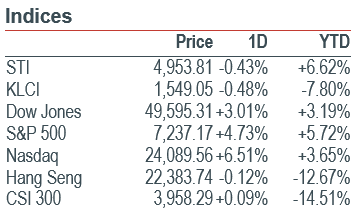
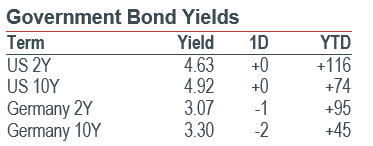
Market Movers: The S&P 500 rose 4.7% to 7,237.17 on 23 November, ending a seven-session slide. The Nasdaq gained 6.5%. Nvidia (NVDA US) rose 31.5% to US$165.05 after its board brought Jensen Huang back as chief executive. Harvey Jones remains chair. Colette Kress keeps her role as finance chief. An independent inquiry into reports of foreign intelligence targeting continues. Zscaler (ZS US) rose 17.7% to US$229.24 after CrowdStrike (CRWD US) agreed to an all-stock deal valuing the business at US$43.9bn. CrowdStrike fell 8.9% to US$208.97. Each Zscaler share would receive 1.135 CrowdStrike shares. At the close that put the offer at US$237.18 a share, down from US$260.41 when announced. Zscaler holders remain exposed to the buyer’s share price until closing. (Nvidia / CrowdStrike / AP) Nvidia (NVDA US) is our Core Recommendation.
Macro: US businesses reported the slowest growth in four months in the November flash survey. The composite index fell to 54.6 from 55.9. Services lost more momentum than factories as high prices held back new orders. Factories reported little change in orders, but longer delivery times made it harder to fill them. Both sectors continued to hire. The survey still pointed to US growth of 3% at an annual rate in 4Q, according to S&P Global. In the euro area, the composite held at 51.7. A reading above 50 means that activity expanded in both economies. (Reuters / S&P Global)
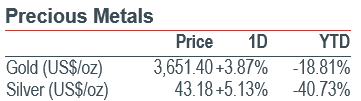
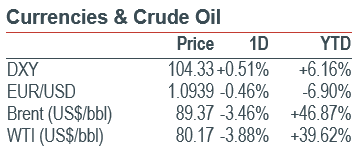
FICC: January Brent lost 3.5% to US$89.37/bbl and WTI fell 3.90% to US$80.17/bbl. Libya’s national oil company said crude was flowing into storage at Zawiya after the Sharara pipeline reopened. That added to supplies reaching market from the Middle East. December gold gained 3.9% to US$3,651.40/oz and silver rose 5.1% to US$43.18/oz. The US dollar index rose 0.51% at 104.33 in live trading at 05:27 SGT on 24 November. (Reuters / Newsquawk / AP)
AI
Nvidia reinstates Huang as chief executive. Nvidia (NVDA US) rose 31.5% to US$165.05 after reinstating Jensen Huang as chief executive and a director. Harvey Jones remains chair. The board said input from senior US officials informed its decision. Its investigation into possible foreign intelligence targeting continues, and a new chief compliance officer will report directly to the board committee. (Nvidia / AP) Nvidia (NVDA US) is our Core Recommendation.
Oracle funding assurance draws buyers back. Oracle (ORCL US) rose 12.3% to US$113.68 in the first regular session after the 20 November post-close statement that its OpenAI contract was fully funded. The company said vendor financing was in place and further talks were optional. It expects positive free cash flow in 2H FY28, so near-term construction spending still runs ahead of cash generation. (Oracle / AP)
Applied Digital signs an 18-year lease. Applied Digital (APLD US) gained 20.30% to US$13.82 after securing a 150MW lease with an unnamed investment-grade customer. The initial term adds US$5.4bn to contracted revenue, taking its portfolio above US$41bn. Capacity delivery is scheduled to begin in the first half of 2028, subject to power arrangements, development milestones and regulatory approvals. (Applied Digital / Investing.com)
HPE lifts guidance as server margins rise. Hewlett Packard Enterprise (HPE US) reported after the US close that quarterly sales rose 50% to US$14.5bn. Cloud and AI revenue grew 68.6% to US$11.3bn, and its operating margin rose to 18.4% from 9.3% a year earlier. HPE now expects FY27 revenue of US$59.4bn–63.1bn and authorised a further US$5bn of share repurchases. (HPE)
Americas
CrowdStrike puts a US$43.9bn enterprise value on Zscaler. Zscaler (ZS US) rose 17.7% to US$229.24 and CrowdStrike (CRWD US) fell 8.9% to US$208.97. Each Zscaler share would receive 1.135 CrowdStrike shares, putting the offer value at US$237.18 at the close. The companies expect to save US$500m a year within 18–24 months of closing. Zscaler shareholders and regulators must approve the deal. (CrowdStrike / Reuters)
Capricor weighs job cuts after FDA rejection. Capricor Therapeutics (CAPR US) fell 74.7% to US$1.92, its first regular session after the FDA declined to approve deramiocel. The regulator cited problems with the reliability of trial data. Chief executive Linda Marbán told Reuters the company could not fund the requested new study and was considering several hundred job cuts. (FDA / Reuters)
Agilent sets a 6–8% revenue growth target. Agilent Technologies (A US) reported after the US close that 4Q sales rose 9.6% to US$2.04bn, or 8.3% on its core measure. It expects FY27 revenue of US$8.00bn–8.15bn, up 6–8%. A tariff refund contributed US$0.07 to 4Q adjusted earnings of US$1.86 per share, a benefit investors should separate from recurring earnings. (Agilent)
Zoom initiates a dividend as enterprise sales grow. Zoom Communications (ZM US) reported after the US close that 3Q sales rose 4.9% to US$1.29bn. Enterprise revenue rose 8.6% to US$805.4m while online revenue fell 0.60%, leaving business customers as the main source of growth. The board declared an initial quarterly cash dividend of US$0.25 a share. (Zoom)
Greater China
VNET data-centre growth came with a widening gap between capacity and use. VNET (VNET US) rose 16.5% to US$2.54 after 3Q results. Wholesale revenue rose 27.6% YoY to RMB1.22bn, and the operator secured a 60MW order from a cloud provider. Capacity in service rose 44.1% to 1,127MW while capacity used grew 37.1% to 797MW. Filling commissioned sites will matter to returns as the group commits more capital to new ones. (VNET / Stock Analysis)
Leapmotor gross margin falls as sales grow. Leapmotor (9863.HK) fell 13.0% to HK$26.52 in the first Hong Kong session after its 3Q results. Revenue rose 63.0% YoY to RMB31.7bn, but gross margin fell to 10.9% from 14.5% a year earlier. Profit attributable to shareholders shrank to RMB40m from RMB150m. Higher raw-material costs and a less profitable model mix left the carmaker retaining less of each additional sale. (Leapmotor / Dow Jones / etnet)
Want Want loses sales through traditional wholesalers. Want Want China (0151.HK) dropped 15.5% to HK$2.405 after its midday interim results. Revenue fell 9.7% YoY to RMB10.0bn, while profit attributable to shareholders declined 39.9% to RMB1.03bn. Traditional wholesale accounts for more than half of sales and posted a double-digit decline. Operating margin narrowed to 13.9% from 20.4%, leaving less profit on each sale. (Want Want China / The Standard / NewTimeSpace)
Hongkong Land raises its profit outlook. Hongkong Land (H78 SP) gained 2.4% to US$8.59 in the first Singapore session after its trading update. Underlying 3Q profit grew 38% YoY, and management raised its full-year growth forecast to the mid-teens. Spot rents in Hong Kong’s Central district rose 13.9% in the first nine months. Higher spot rents can support earnings as existing leases come up for renewal. (Hongkong Land / The Business Times / Stock Analysis)
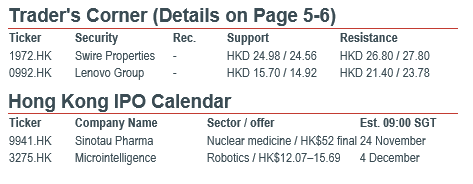
Microintelligence cuts its proposed IPO price range. Changzhou Microintelligence (3275.HK), an industrial robotics supplier, is offering 37.28m shares at HK$12.07–15.69 each. The top price implies gross proceeds of HK$584.9m before the overallotment option. The prospectus permits a further cut of up to 10% below the indicative floor. The revised terms leave room to attract buyers and reduce the funding available if demand proves weak. (HKEX / The Standard)
Asia ex. China
BHP puts a price on South Australia’s copper expansion. BHP (BHP AU) rose 2.2% to A$52.52 as it presented a pathway to 650,000 tonnes of annual copper output by 2040. BHP estimates the investment at US$14.2bn–18.1bn, with a final investment decision expected in 1H27. The plan expands processing at existing mines. The spending still needs approval. (BHP / Reuters / Stock Analysis)
Tata Steel moved to combine its downstream businesses with APL Apollo. Tata Steel (TATASTEEL IN) fell 8.4% to INR163.00 and APL Apollo Tubes (APLAPOLLO IN) lost 21.3% to INR1,670.00. Tata agreed to buy the promoters’ 26.6% stake and announced an open offer for a further 26%. It also plans to sell its tubes and colour-coated businesses to APL Apollo for up to INR280bn. Tata’s eventual stake depends on how many shareholders tender. (Tata Steel / Stock Analysis / Economic Times)
Taiwan’s chip shares rebound under new short-sale rules. The TAIEX rose 2.2% to 36,811.89 after the regulator barred ordinary short sales below the prior close. Taiwan Semiconductor Manufacturing’s local shares (2330.TW) rose 1.5% to NT$2,030. Financial stocks dropped 2.6% even as chipmakers recovered, showing how uneven the recovery was. (Taiwan FSC / Central News Agency) Taiwan Semiconductor Manufacturing ADR (TSM US) is our Core Recommendation.
Chips account for half of South Korea’s exports. Exports reached US$77.4bn in the first 20 days of November, up from US$38.4bn a year earlier. Chips accounted for US$38.5bn, or 49.7% of total shipments. The KOSPI nevertheless fell 3.3% to 4,708.54. Chip demand supported the trade surplus, leaving the trade surplus exposed if chip orders slow. (Korea Customs Service / Yonhap / MoneyToday)
ALS’s weaker life-sciences outlook overshadowed earnings growth. ALS (ALQ AU) fell 12.20% to A$16.94 after reporting a 23.6% YoY increase in underlying first-half net profit to A$214.6m. Commodity testing delivered 24.5% organic revenue growth, against 1.8% in life sciences, where pharmaceutical sales declined. Management now expects 3% organic growth in life sciences for FY27, leaving more of the group’s growth dependent on mining customers. (ALS / Market Index / Stock Analysis)
EMEA and Others
Drax lifts its earnings outlook on flexible power sales. Drax (DRX LN) gained 5.2% to 864p after signalling 2026 adjusted EBITDA significantly above the £721m analyst consensus. The group added £50m to its contracted power position as generation and grid support strengthened. Management sees £800m–900m of adjusted EBITDA in 2029 from existing and committed projects. Its £1bn-plus ambition for 2031 requires further investment. (Drax / Reuters)
Julius Baer gains assets but flags further client exits. Julius Baer (BAER SW) fell 1.8% to CHF64.22. Ten-month adjusted pretax profit reached CHF1.3bn, up 17% from the prior year’s underlying result. Net new money of CHF8.5bn helped lift assets to CHF553bn. The Swiss bank identified client relationships representing less than 2.5% of assets for exit and aims to complete most of that work by end-2027. (Julius Baer / Reuters)
Abivax defends bowel drug data after a short report. Abivax (ABVX FP) rose 4.7% to €65.95 in the first Paris session after its 20 November post-close response to Scorpion Capital. The company disputed the short seller’s claims about its experimental ulcerative colitis drug and maintained its plan to file for US approval by year-end. The statement provided no new clinical results. (Abivax / Reuters)
Traders' Corner
Our Technical View
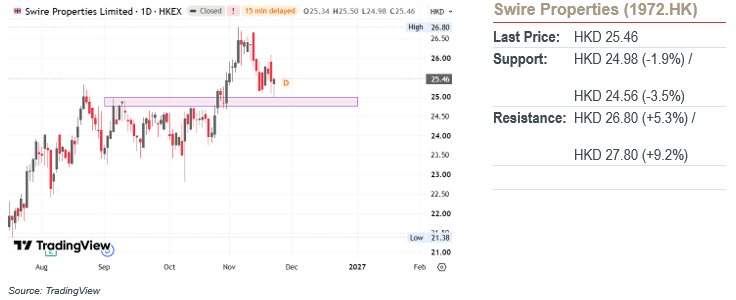
Price holds firmly above its resistance-turned-support zone throughout its recent retracement.
The RSI remains in bullish territory and is actively ticking higher from its neutral 50 level.
Provided price remains supported above the resistance-turned-support floor, we see a sustained rebound toward higher overhead resistance levels.
Our Technical View
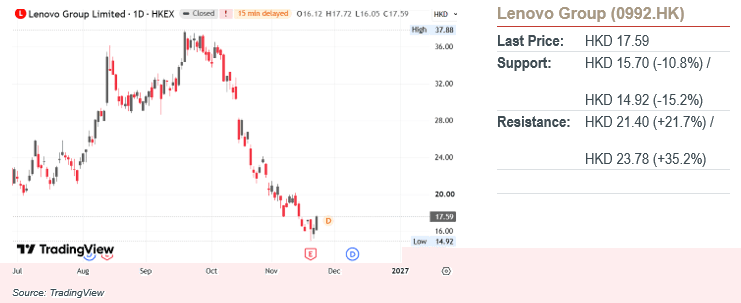
Price signals a potential bottoming formation as downward progression stabilizes around the HK$14.92 support threshold.
The RSI has remained in the extended oversold zone, highlighting that the preceding markdown phase has reached a stretched technical extreme.
Provided price holds strictly above the HK$14.92 structural floor, we see a sustained rebound toward higher overhead resistance levels.
Market Movers: The S&P 500 rose 4.7% to 7,237.17 on 23 November, ending a seven-session slide. The Nasdaq gained 6.5%. Nvidia (NVDA US) rose 31.5% to US$165.05 after its board brought Jensen Huang back as chief executive. Harvey Jones remains chair. Colette Kress keeps her role as finance chief. An independent inquiry into reports of foreign intelligence targeting continues. Zscaler (ZS US) rose 17.7% to US$229.24 after CrowdStrike (CRWD US) agreed to an all-stock deal valuing the business at US$43.9bn. CrowdStrike fell 8.9% to US$208.97. Each Zscaler share would receive 1.135 CrowdStrike shares. At the close that put the offer at US$237.18 a share, down from US$260.41 when announced. Zscaler holders remain exposed to the buyer’s share price until closing. (Nvidia / CrowdStrike / AP) Nvidia (NVDA US) is our Core Recommendation.
Macro: US businesses reported the slowest growth in four months in the November flash survey. The composite index fell to 54.6 from 55.9. Services lost more momentum than factories as high prices held back new orders. Factories reported little change in orders, but longer delivery times made it harder to fill them. Both sectors continued to hire. The survey still pointed to US growth of 3% at an annual rate in 4Q, according to S&P Global. In the euro area, the composite held at 51.7. A reading above 50 means that activity expanded in both economies. (Reuters / S&P Global)
FICC: January Brent lost 3.5% to US$89.37/bbl and WTI fell 3.90% to US$80.17/bbl. Libya’s national oil company said crude was flowing into storage at Zawiya after the Sharara pipeline reopened. That added to supplies reaching market from the Middle East. December gold gained 3.9% to US$3,651.40/oz and silver rose 5.1% to US$43.18/oz. The US dollar index rose 0.51% at 104.33 in live trading at 05:27 SGT on 24 November. (Reuters / Newsquawk / AP)
AI
Nvidia reinstates Huang as chief executive. Nvidia (NVDA US) rose 31.5% to US$165.05 after reinstating Jensen Huang as chief executive and a director. Harvey Jones remains chair. The board said input from senior US officials informed its decision. Its investigation into possible foreign intelligence targeting continues, and a new chief compliance officer will report directly to the board committee. (Nvidia / AP) Nvidia (NVDA US) is our Core Recommendation.
Oracle funding assurance draws buyers back. Oracle (ORCL US) rose 12.3% to US$113.68 in the first regular session after the 20 November post-close statement that its OpenAI contract was fully funded. The company said vendor financing was in place and further talks were optional. It expects positive free cash flow in 2H FY28, so near-term construction spending still runs ahead of cash generation. (Oracle / AP)
Applied Digital signs an 18-year lease. Applied Digital (APLD US) gained 20.30% to US$13.82 after securing a 150MW lease with an unnamed investment-grade customer. The initial term adds US$5.4bn to contracted revenue, taking its portfolio above US$41bn. Capacity delivery is scheduled to begin in the first half of 2028, subject to power arrangements, development milestones and regulatory approvals. (Applied Digital / Investing.com)
HPE lifts guidance as server margins rise. Hewlett Packard Enterprise (HPE US) reported after the US close that quarterly sales rose 50% to US$14.5bn. Cloud and AI revenue grew 68.6% to US$11.3bn, and its operating margin rose to 18.4% from 9.3% a year earlier. HPE now expects FY27 revenue of US$59.4bn–63.1bn and authorised a further US$5bn of share repurchases. (HPE)
Americas
CrowdStrike puts a US$43.9bn enterprise value on Zscaler. Zscaler (ZS US) rose 17.7% to US$229.24 and CrowdStrike (CRWD US) fell 8.9% to US$208.97. Each Zscaler share would receive 1.135 CrowdStrike shares, putting the offer value at US$237.18 at the close. The companies expect to save US$500m a year within 18–24 months of closing. Zscaler shareholders and regulators must approve the deal. (CrowdStrike / Reuters)
Capricor weighs job cuts after FDA rejection. Capricor Therapeutics (CAPR US) fell 74.7% to US$1.92, its first regular session after the FDA declined to approve deramiocel. The regulator cited problems with the reliability of trial data. Chief executive Linda Marbán told Reuters the company could not fund the requested new study and was considering several hundred job cuts. (FDA / Reuters)
Agilent sets a 6–8% revenue growth target. Agilent Technologies (A US) reported after the US close that 4Q sales rose 9.6% to US$2.04bn, or 8.3% on its core measure. It expects FY27 revenue of US$8.00bn–8.15bn, up 6–8%. A tariff refund contributed US$0.07 to 4Q adjusted earnings of US$1.86 per share, a benefit investors should separate from recurring earnings. (Agilent)
Zoom initiates a dividend as enterprise sales grow. Zoom Communications (ZM US) reported after the US close that 3Q sales rose 4.9% to US$1.29bn. Enterprise revenue rose 8.6% to US$805.4m while online revenue fell 0.60%, leaving business customers as the main source of growth. The board declared an initial quarterly cash dividend of US$0.25 a share. (Zoom)
Greater China
VNET data-centre growth came with a widening gap between capacity and use. VNET (VNET US) rose 16.5% to US$2.54 after 3Q results. Wholesale revenue rose 27.6% YoY to RMB1.22bn, and the operator secured a 60MW order from a cloud provider. Capacity in service rose 44.1% to 1,127MW while capacity used grew 37.1% to 797MW. Filling commissioned sites will matter to returns as the group commits more capital to new ones. (VNET / Stock Analysis)
Leapmotor gross margin falls as sales grow. Leapmotor (9863.HK) fell 13.0% to HK$26.52 in the first Hong Kong session after its 3Q results. Revenue rose 63.0% YoY to RMB31.7bn, but gross margin fell to 10.9% from 14.5% a year earlier. Profit attributable to shareholders shrank to RMB40m from RMB150m. Higher raw-material costs and a less profitable model mix left the carmaker retaining less of each additional sale. (Leapmotor / Dow Jones / etnet)
Want Want loses sales through traditional wholesalers. Want Want China (0151.HK) dropped 15.5% to HK$2.405 after its midday interim results. Revenue fell 9.7% YoY to RMB10.0bn, while profit attributable to shareholders declined 39.9% to RMB1.03bn. Traditional wholesale accounts for more than half of sales and posted a double-digit decline. Operating margin narrowed to 13.9% from 20.4%, leaving less profit on each sale. (Want Want China / The Standard / NewTimeSpace)
Hongkong Land raises its profit outlook. Hongkong Land (H78 SP) gained 2.4% to US$8.59 in the first Singapore session after its trading update. Underlying 3Q profit grew 38% YoY, and management raised its full-year growth forecast to the mid-teens. Spot rents in Hong Kong’s Central district rose 13.9% in the first nine months. Higher spot rents can support earnings as existing leases come up for renewal. (Hongkong Land / The Business Times / Stock Analysis)
Microintelligence cuts its proposed IPO price range. Changzhou Microintelligence (3275.HK), an industrial robotics supplier, is offering 37.28m shares at HK$12.07–15.69 each. The top price implies gross proceeds of HK$584.9m before the overallotment option. The prospectus permits a further cut of up to 10% below the indicative floor. The revised terms leave room to attract buyers and reduce the funding available if demand proves weak. (HKEX / The Standard)
Asia ex. China
BHP puts a price on South Australia’s copper expansion. BHP (BHP AU) rose 2.2% to A$52.52 as it presented a pathway to 650,000 tonnes of annual copper output by 2040. BHP estimates the investment at US$14.2bn–18.1bn, with a final investment decision expected in 1H27. The plan expands processing at existing mines. The spending still needs approval. (BHP / Reuters / Stock Analysis)
Tata Steel moved to combine its downstream businesses with APL Apollo. Tata Steel (TATASTEEL IN) fell 8.4% to INR163.00 and APL Apollo Tubes (APLAPOLLO IN) lost 21.3% to INR1,670.00. Tata agreed to buy the promoters’ 26.6% stake and announced an open offer for a further 26%. It also plans to sell its tubes and colour-coated businesses to APL Apollo for up to INR280bn. Tata’s eventual stake depends on how many shareholders tender. (Tata Steel / Stock Analysis / Economic Times)
Taiwan’s chip shares rebound under new short-sale rules. The TAIEX rose 2.2% to 36,811.89 after the regulator barred ordinary short sales below the prior close. Taiwan Semiconductor Manufacturing’s local shares (2330.TW) rose 1.5% to NT$2,030. Financial stocks dropped 2.6% even as chipmakers recovered, showing how uneven the recovery was. (Taiwan FSC / Central News Agency) Taiwan Semiconductor Manufacturing ADR (TSM US) is our Core Recommendation.
Chips account for half of South Korea’s exports. Exports reached US$77.4bn in the first 20 days of November, up from US$38.4bn a year earlier. Chips accounted for US$38.5bn, or 49.7% of total shipments. The KOSPI nevertheless fell 3.3% to 4,708.54. Chip demand supported the trade surplus, leaving the trade surplus exposed if chip orders slow. (Korea Customs Service / Yonhap / MoneyToday)
ALS’s weaker life-sciences outlook overshadowed earnings growth. ALS (ALQ AU) fell 12.20% to A$16.94 after reporting a 23.6% YoY increase in underlying first-half net profit to A$214.6m. Commodity testing delivered 24.5% organic revenue growth, against 1.8% in life sciences, where pharmaceutical sales declined. Management now expects 3% organic growth in life sciences for FY27, leaving more of the group’s growth dependent on mining customers. (ALS / Market Index / Stock Analysis)
EMEA and Others
Drax lifts its earnings outlook on flexible power sales. Drax (DRX LN) gained 5.2% to 864p after signalling 2026 adjusted EBITDA significantly above the £721m analyst consensus. The group added £50m to its contracted power position as generation and grid support strengthened. Management sees £800m–900m of adjusted EBITDA in 2029 from existing and committed projects. Its £1bn-plus ambition for 2031 requires further investment. (Drax / Reuters)
Julius Baer gains assets but flags further client exits. Julius Baer (BAER SW) fell 1.8% to CHF64.22. Ten-month adjusted pretax profit reached CHF1.3bn, up 17% from the prior year’s underlying result. Net new money of CHF8.5bn helped lift assets to CHF553bn. The Swiss bank identified client relationships representing less than 2.5% of assets for exit and aims to complete most of that work by end-2027. (Julius Baer / Reuters)
Abivax defends bowel drug data after a short report. Abivax (ABVX FP) rose 4.7% to €65.95 in the first Paris session after its 20 November post-close response to Scorpion Capital. The company disputed the short seller’s claims about its experimental ulcerative colitis drug and maintained its plan to file for US approval by year-end. The statement provided no new clinical results. (Abivax / Reuters)
Traders' Corner
Our Technical View
Price holds firmly above its resistance-turned-support zone throughout its recent retracement.
The RSI remains in bullish territory and is actively ticking higher from its neutral 50 level.
Provided price remains supported above the resistance-turned-support floor, we see a sustained rebound toward higher overhead resistance levels.
Our Technical View
Price signals a potential bottoming formation as downward progression stabilizes around the HK$14.92 support threshold.
The RSI has remained in the extended oversold zone, highlighting that the preceding markdown phase has reached a stretched technical extreme.
Provided price holds strictly above the HK$14.92 structural floor, we see a sustained rebound toward higher overhead resistance levels.
Disclosures and disclaimers
This report is provided subject to, and must be read together with, the full Disclosures / Disclaimers available at this link, which are incorporated by reference into this report. In particular, this report is intended for general circulation and informational purposes only and does not constitute personal investment advice or a recommendation to buy or sell any investment product or security. You should independently evaluate the information and, where necessary, seek advice from a qualified financial adviser regarding the suitability of any investment. Analyst certifications required under applicable regulations, including SEC Regulation AC (where relevant), are included in this report. By accessing, receiving or using this report, you acknowledge that you have read, understood and agreed to be bound by the Disclosures / Disclaimers, as may be amended, supplemented or updated from time to time.


